

 Elite
Elite
Mount Everest 15-Day Trekking Tour in Nepal
Free Cancellation · Instant confirmation · Private tour

On arrival at Kathmandu Tribhuvan International Airport you will be received by our staff and transfer you to the Hotel, where our guide will give you a brief orientation of the Hotel, Kathmandu, Trek/Camping, do's and don't and other related information that you might require while in Nepal.
After your first night in Kathmandu, you will be well informed on arrival about the time for your half day guided sightseeing tour in Kathmandu at places of interest. Swoyambhunath ( Monkey Temple) Situated on a hill, Swoyambhunath is both a Buddhist and a Hindu Temple. The origin of Kathmandu valley is closely linked to this temple. Also known as Monkey Temple, the sprawling tree-filled grounds of the temple is home to many monkeys.
Swoyambhunath ( Monkey Temple)
Situated on a hill, Swoyambhunath is both a Buddhist and a Hindu Temple. The origin of Kathmandu valley is closely linked to this temple. Also known as Monkey Temple, the sprawling tree-filled grounds of the temple is home to many monkeys.
Pashupatinath Temple
Pashupatinath Temple is one of the holiest Hindu shrines in the world. Dedicated to Lord Shiva, the temple lies 5 kms east of the city center. The richly-ornamented pagoda houses the sacred Linga, or phallic symbol, of Lord Shiva.
Boudhanath Stupa
Boudhanath Stupa is an important Buddhist pilgrimage site. The white domed stupa stands on a giant mandala. Built during the 5th century, Boudhanath is an important centre of Tibetan Buddhism. Legend has it that the bones of Kasyapa Buddha(one of Buddha’s incarnations) lies at the base of this stupa.
Bhaktapur Durbar Square
Bhaktapur Durbar Square lies in Bhaktapur, one of the three medieval cities in Kathmandu Valley. The royal square, which was built by the Malla royals, houses some of the best examples of ancient Newari art and architecture. The five-tiered pagoda temple Nyatapola, Palace of 55 Windows, Vatsala Temple, Bhairavnath Temple, Duttaraya Temple, Pujari Math, Golden Gate etc are all cultural treasures of this beautifully preserved UNESCO World Heritage Site.
Transfer to the domestic airport for one of the great flights of the Himalaya. If the sky is clear during the flight, one can get the first views of the Mt.Everest. The Twin-Otter / Dronier or similar aircraft will take to the hillside village of Lukla, the starting point of the trek. Here meet the staff and the porters and set off straight away for Phakding, situated on the banks of the Dudh Kosi River, which drains the whole of the Khumbu.
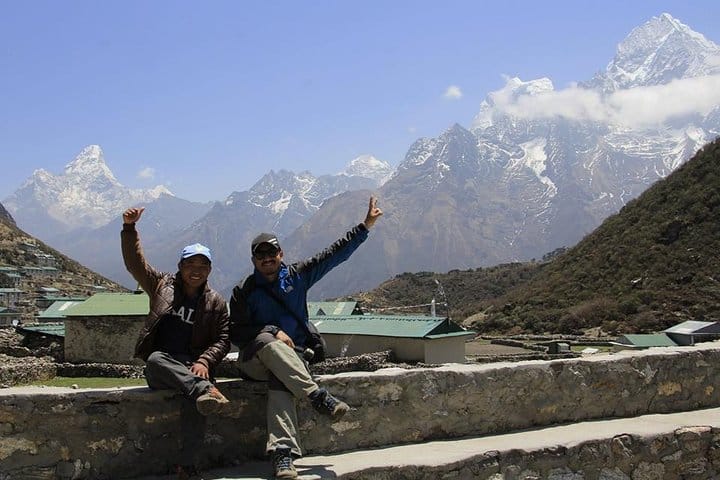
Walk continues up the banks of the Dudh Kosi River, crossing it twice by small suspension bridges, before reaching the village of Monjo, which is the entrance to the Khumbu National Park. Then cross the confluence of the Dudh Kosi and Bhote Kosi rivers on a high suspension bridge and climb steeply for about two hours to Namche Bazaar. This is a prosperous trading town and is the capital of the Khumbu region. Many Tibetans cross the nearby border to trade their wares and the local market is a fascinating spectacle. This is a good place to buy genuine Tibetan artifacts. Just across the valley to the east stand the peaks of Thamserku and Kangtega, both very impressive mountains.
Rest and at leisure allowing the bodies to become more acclimatized to the altitude of 11,300ft /3,440m.
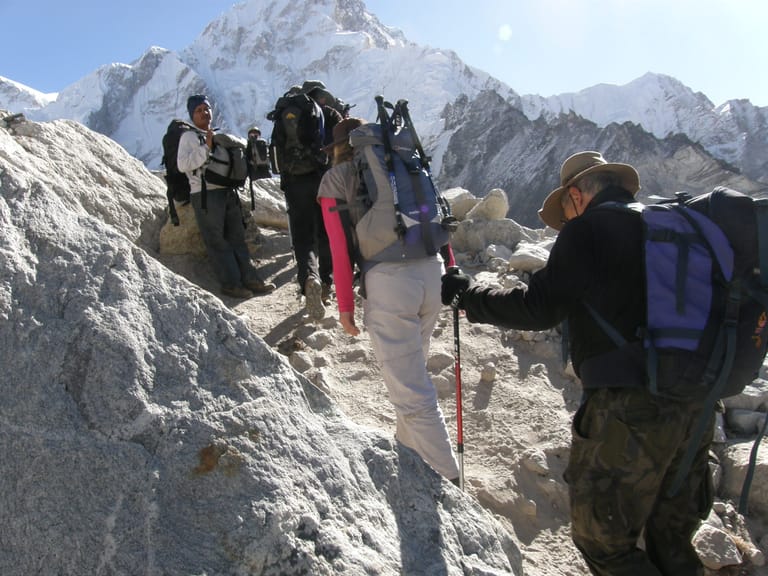
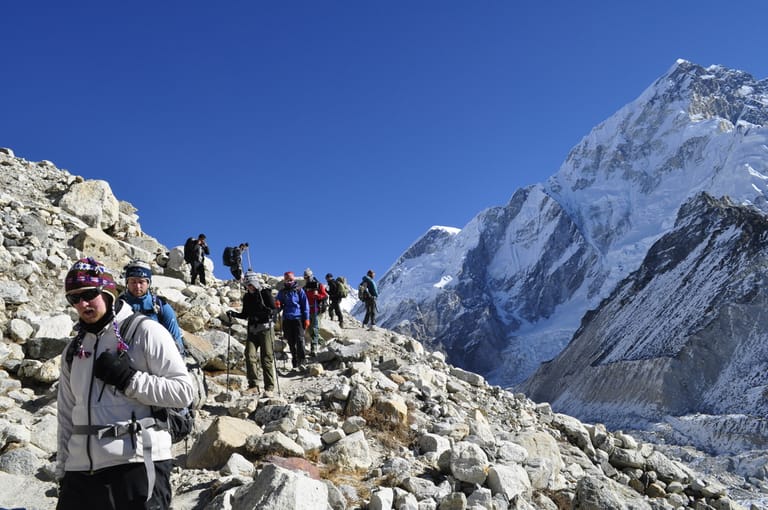
The well worn Everest trail contours around the side of the valley high above the Dudh Kosi, with good views of the great peaks of the Khumbu including - Everest, Lhotse, Nuptse and Ama Dablam and then passing several villages and numerous tea shops, descending steeply to a bridge over the Dudh Kosi. The village on the far side is an excellent lunch spot and here one can rest a little before making the steep climb to Thyangboche. Although tiring, the 2 hours haul up the zig-zag path has numerous distractions, with rhododendron bushes, beautiful birds and superb mountain scenery. Thyangboche is famous for its monastery, the largest in the Khumbu. It was completely destroyed by fire (an elderly monk tried to put out his new electric fire by pushing it face down onto the floor!) but it has now been rebuilt and is as grand as ever.
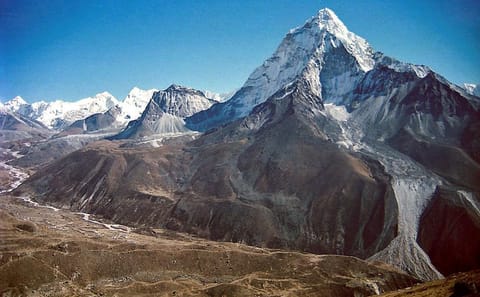
Descending gradually through woods, cross the Imja tse Khola and climb steadily to the village of Pangboche. This is directly opposite of Ama Dablam (6,856 m.), and is a good place to stop-by for the lunch and overnight camp overlooking the excellent view of Ama Dablam, Kangtenga and Thermasarkhu. Afternoon free for local hike to the upper village and visit the local old monastery.
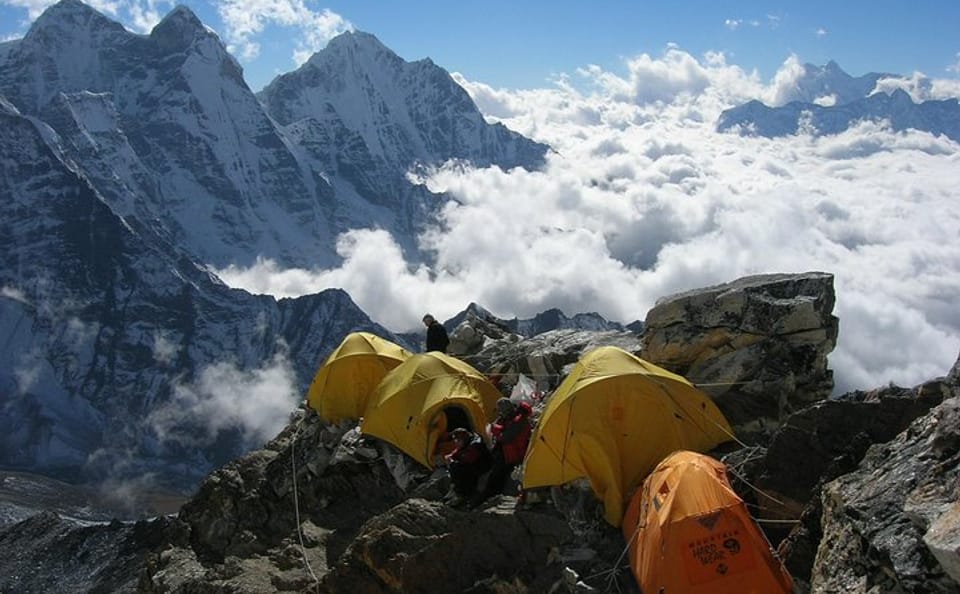
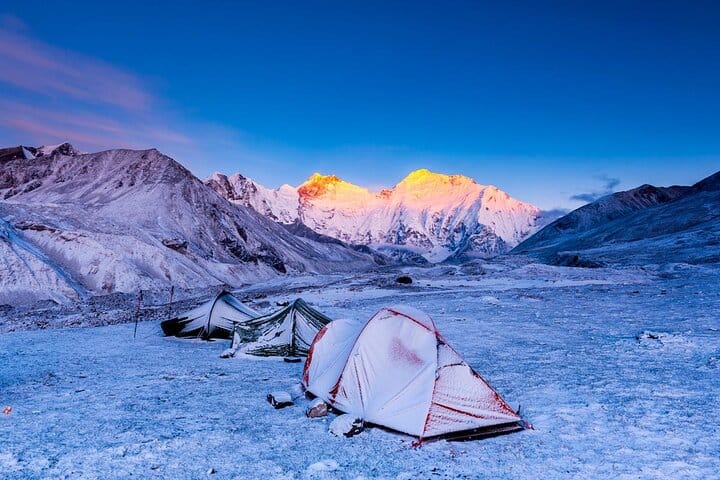
From the camp descend towards the Imjatse River and cross the small wooden bridge, after the river a steep climb of 40 minutes leads to a large meadow with couple of Shepard huts. From here the walk is on the gradual uphill path till the base of Ama Dablam is reached. The camp is on the large field beneath the towering majestic peak of Ama Dablam.
A rest day, an optional hike towards the advance camp with the wonderful views of the surrounding beautiful landscapes.
During these 12 days you will be engrossed dividing the loads and checking your equipment for the final assault.
It is impossible to predict the exact day by day itinerary for this period. The team will be broken down into climbing groups who will work on the mountain for several days before returning for a rest at Base Camp. While one group is pushing out the route and fixing ropes another maybe carrying loads up to higher camps. Ray Delaney climbed the South West ridge of Ama Dablam with Joe Simpson in April 1990.
His route description is as follows. From Base Camp follow old grassy moraine ridges roughly eastwards to a broad saddle from one can see a Mingbo-La. From the saddle turn north and climb up rocky ground and finally through boulders to the ridge below Pt.5, 705 which is the site of camp I. There are four or five tents platforms.
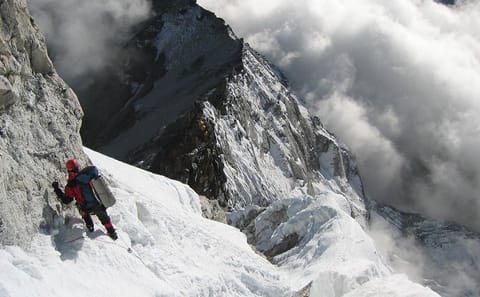
From Camp I: Cross a rocky bowl (tricky if snow covered) until below two rock fingers, then move on to a ridge proper. Climbing the ridge involves rock climbing of severe standard with steps of VS (USA 5.6) Camp II is at the top yellow tower, which gives one of the hardest pitches on the climb at VS/Hard VS (5.8).
From Camp II:
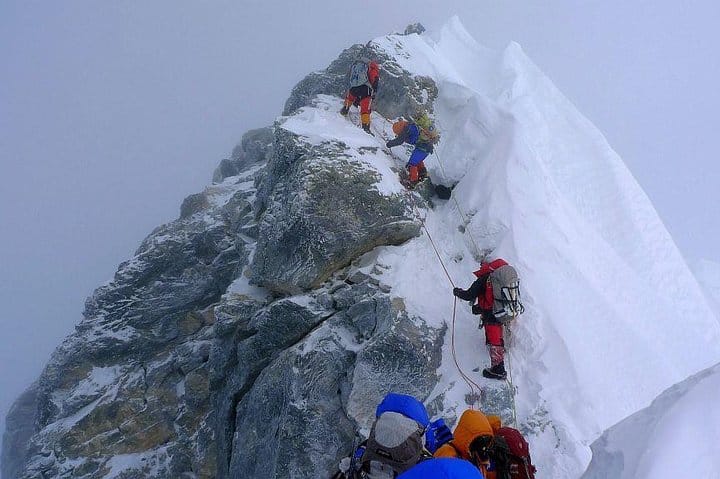
Skirt a red rock bluff on the east and follow a ramp line to a gray tower. Move into the ramp (some stone fall danger) and climb to an amphitheater. Continue up a broad gully on between the gray tower and the lower rock buttress and climb a snow slope to ' Santa's Grotto' at the start of Mushroom ridge. Possible bivvy site Follow the mushroom ridge to a crevasse in the upper face, which offers another good bivvy site. Climb the snow/ Ice slope to the right of the face, and then follow mixed ground to the top of the highest hanging glacier. An ice crest now leads in a magnificent position to the summit.
Grand Views! We all need to be back at the base camp by Day 21-22. At this point the porters will arrive for our walk out to Lukla.
Today after regaining the energy back after the hard climb, every one will be engaged cleaning up the base camp and packing. Please take all the dead used or unused batteries back home.
An easy downhill of few hours brings you back to the Imjatse River after the river a short climb towards Pangboche.
Retrace the journey back to Monjo via Namche Bazaar for the overnight stop.
Last day of this great trek will be one of the good walk to Lukla, enjoying the lush green scenery around. Apart from few short uphill the only long climb will be just before Lukla which will take approximately 40 minutes from a place called Chop lung or from the old big oak tree. On reaching Lukla, prepare for the last day great dinner and a party with the fellow Sherpa crew, porters and trekking members.
The flight time to Kathmandu, are schedule for morning normally, because of the wind in the afternoon, sometime the flight time can be delayed due to bad weather and other reason. This scenic flight from Lukla takes about 45 minutes to Kathmandu, a panoramic view of the snow capped peaks can be seen from window of the plane. Arriving at Kathmandu domestic terminal, our staff will receive and transfer you back to the Hotel.
A free day in Kathmandu, please inform our staff if you would like to go on another short tour in and around Kathmandu Valley.
In the evening, enjoy a complimentary farewell dinner at a local Nepali restaurant with cultural program.
Today as per your international flight time, keep your confirmed air ticket, and your passport handy. Our office staff will take you to the airport for your final departure from this amazing country, Nepal.
Fully refundable until 1 day before start
Non-refundable after 1 day before start
Elite
Free Cancellation · Instant confirmation · Private tour
 Elite
Elite
Free Cancellation · Instant confirmation · Meet on location or pickup
Free Cancellation · Instant confirmation · Private tour
Free Cancellation · Instant confirmation · Private tour
Free Cancellation · Instant confirmation · Private tour
Free Cancellation · Instant confirmation · Private tour
Free Cancellation · Instant confirmation · Min age 16+
Free Cancellation · Instant confirmation · Min age 14+
Our assistant finds tours and checks live dates and prices, and answers your questions.