

 Elite
Elite
Discover Bhutan 5-Day Cultural Tour
Free Cancellation · Instant confirmation · Private tour

Our guide and the driver will receive you at the Paro International Airport and escort you to visit the National Museum of Bhutan housed in a watchtower called Ta Dzong (Ta Dzong means “watchtower fortress”) built in 1649. The collection at the National Museum preserves a snapshot of the rich history and cultural traditions of the country.
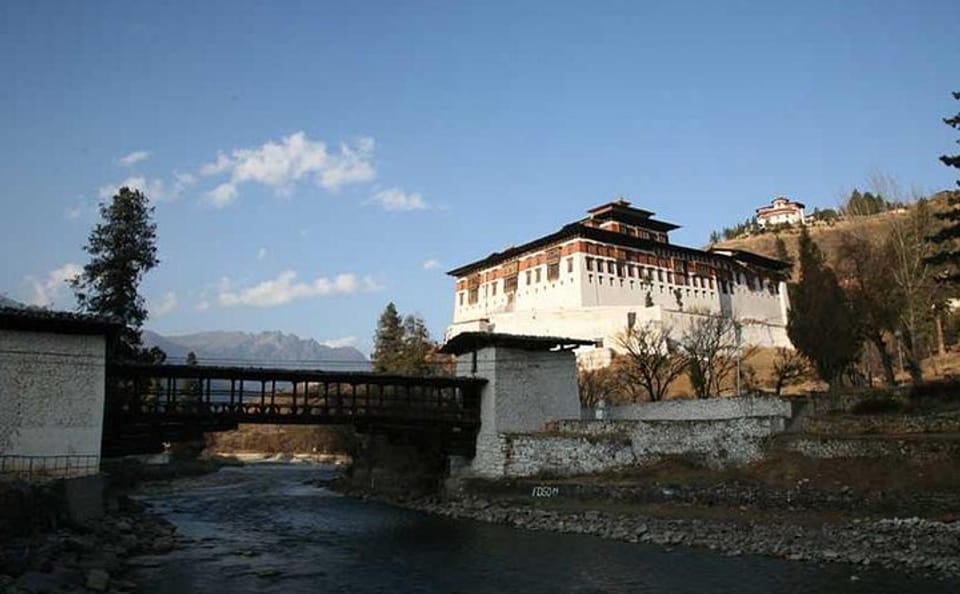
Next visit Paro Rinpung Dzong (Rinpung Dzong means “fortress of the heap of jewels”) built by Zhabdrung Ngawang Namgyel in 1646 and established as the administrative and monastic centre of the western region. Today, the Dzong serves as the office of the governor of Paro district and head of the district monk body in Paro. After visiting the Dzong, take a short walk to the picturesque traditional wooden cantilever bridge called Nemeyzampa, where your driver will be waiting for you. The roofed wooden cantilever bridge is built in a traditional style and this type of bridge is called Bazam. From here, transfer to the capital city, Thimphu. Lunch can be arranged either in Paro or in Thimphu depending on your flight arrival time.
Distance between Paro & Thimphu is 55km and takes 1.5 hours.
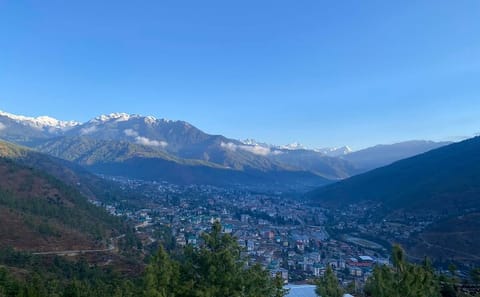
Arriving in Thimphu, visit the magnificent 169 feet tall bronze statue of Lord Buddha located on a hilltop, Kuensel Phodrang, overlooking the Thimphu valley. It was built to celebrate the 60th birth anniversary of the Fourth King His Majesty Jigme Singye Wangchuck and also usher peace in the world.
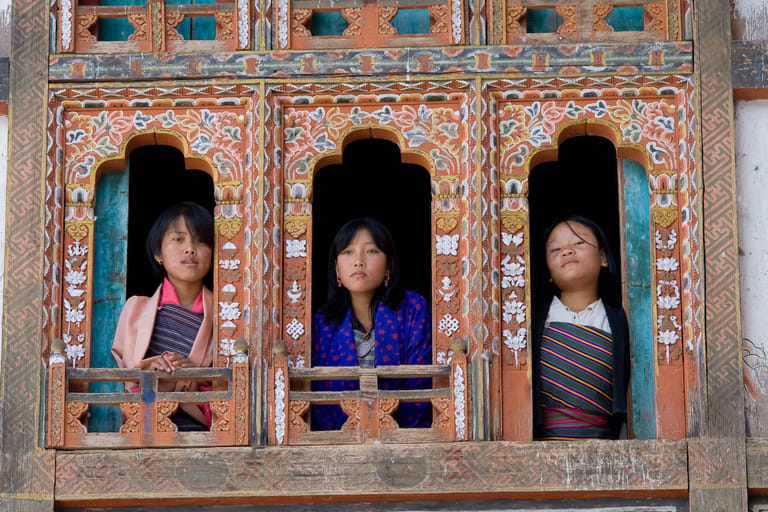
If time permits, visit Weaving Center and get insights into the weaving culture and tradition of the Kingdom of Bhutan. You will see men and women weaving some of the most intricate designs and sophisticated patterns of traditional Bhutanese textiles.
Dinner and overnight at Kuenphen Rabten Resort or Hotel Amodhara
Today, you'll spend the morning in Thimphu and transfer back to Paro in the afternoon. We begin the day by visiting auspicious and the national treasure, Changangkha Lhakhang built in the 13th century by the Tibetan Scholar Lama Drugom Zhigpo who played an important role in the early spread of the Drukpa school of Tibetan Buddhism to Bhutan. His son, Nyima, extended and built many of the statues inside the temple which are invaluable national treasures of Bhutan. Apart from the magnificent statues and other holy scriptures, the temple also has Bum Gye Dring Due Sum (sixteen volumes of Astasahasrika Prajnaparamita) which is the original copy handwritten by Nyima himself.
Next, we visit the Bhutan Postal Museum especially if you are interested in philatelic products and stamp collection. You may also want to print stamps with your own photos. Postal service in Bhutan was launched only in 1962 until which time communications and delivery of mails were done by messengers on foot (building of roads started from 1961). The museum was established in 2015. A bank is also located in the same complex so you can exchange your money into local currency Ngultrum (Nu.) if you want to.
We then go to visit the National Institute for Zorig Chuzum where the 13 Bhutanese arts and crafts are taught. The thirteen arts and crafts are categorized as Shing Zo (woodwork), Dho Zo (stonework), Par Zo (carving), Lha Zo (painting), Jim Zo (sculpting), Lug Zo (casting), Shag Zo (woodturning), Gar Zo (blacksmith), Troe Zo (ornament making), Tsa Zo (bamboo work), De Zo (paper making), Tsem Zo (tailoring, embroidery and applique) and Thag Zo (weaving).
A traditional lunch will be served at the Folk Heritage Restaurant or at a similar one. After lunch, pass by Changlimithang Archery Range to witness the game of archery if the match is in progress. You'll see archers dancing and singing each time they hit the target from a whopping distance of 145m. Archery is the national sport of Bhutan.
From there we drive back to Paro for overnight. Distance between Thimphu and Paro is 55km and takes 1.5 hours.
Arriving is Paro visit one of the oldest temples in Bhutan Kyichu Lhakhang. It is believed to have been built in 659 A.D. by the Tibetan King Songtsen Gampo to subdue the spirit of a giant demoness causing harm to the propagation of Buddhism in the Himalayan region.
Dinner and overnight at Khangkhu Resort or Bhutan Mandala Resort
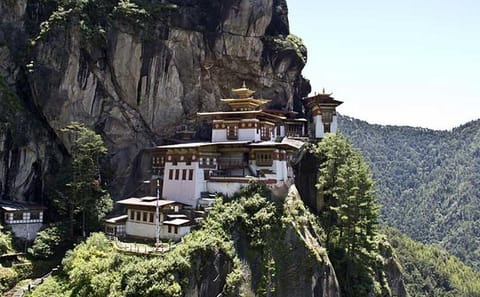
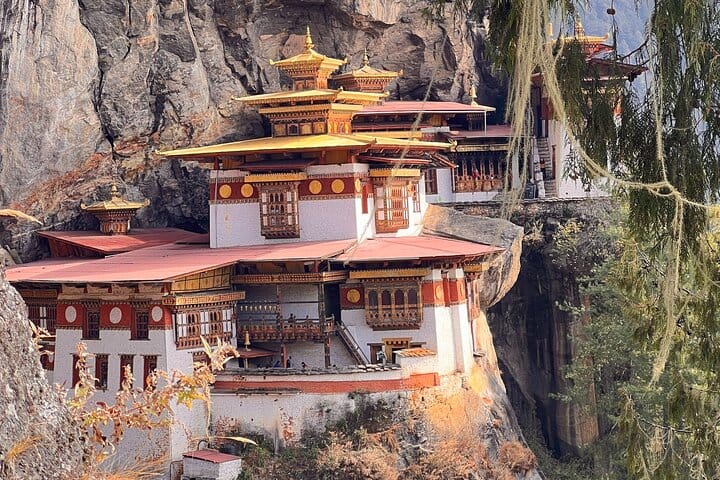
Today, on the 3rd day of your trip, you will hike to the famous 17th century Paro Taktsang Monastery popular known as the “Tiger’s Nest”. Originally built in 1692, the iconic sacred site Taktsang is perched on the 800-meter rock cliff above the valley floor. The round trip hike takes about 4-5 Hours for most visitors. We recommend starting early before the sun gets stronger. One-way horse riding is available for about USD20 up to the midpoint (Taktsang Viewpoint Cafeteria). Horse riding on the way down is not recommended. The history of Taktsang is associated with the visit of Guru Padmasambhava (known as Guru Rinpoche), the Indian saint who came to Bhutan and introduced Tantric Buddhism in the 8th century AD. After lunch at the Taktsang Viewpoint Cafeteria, we retrace our steps back to the base where the driver will be waiting.
Towards the late afternoon, visit one of the beautiful farmhouses and enjoy delicious authentic home-cooked local cuisines. If you are interested, you can soak in a therapeutic and revitalizing traditional hot stone bath for an additional fee of about USD20 per person. Specially selected river stones containing minerals are heated in a wood-fired fireplace and dropped into a chamber of wooden tub releasing minerals.
Overnight at Khangkhu Resort or Bhutan Mandala Resort. You may want to stay overnight at the farmhouse/homestay to experience the life of an ordinary Bhutanese family.
After breakfast, you will be transferred to the Paro International Airport for your onward journey.
Fully refundable until 7 days before start
Non-refundable after 7 days before start
Elite
Free Cancellation · Instant confirmation · Private tour
50% refund until 7 days before · Instant confirmation · Meet on location or pickup
 Elite
Elite
Free Cancellation · Instant confirmation · Pickup available
 Elite
Elite
Free Cancellation · Instant confirmation · Pickup available
 Elite
Elite
Free Cancellation · Instant confirmation · Pickup available
 Elite
Elite
Free Cancellation · Instant confirmation · Min age 12+
 Elite
Elite
Free Cancellation · Instant confirmation · Pickup available
 Elite
Elite
Free Cancellation · Instant confirmation · Min age 12+
Our assistant finds tours and checks live dates and prices, and answers your questions.