

 Elite
Elite
Luxor Valley of the Kings Full-Day Private Tour
Free Cancellation · Instant confirmation · Private tour

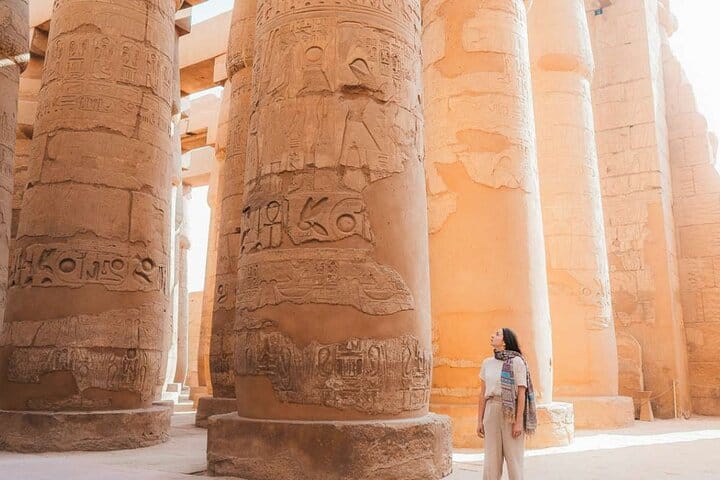
During the New Kingdom, the Karnak Temple Complex was the center of the ancient faith while power was concentrated at Thebes (modern-day Luxor) and its significance is reflected in its enormous size.
In addition to its religious significance, it was also served as a treasury, administrative center, and palace for the New Kingdom pharaohs. It is to this day considered as the largest temple complex ever constructed anywhere in the world.
It developed over a period of 1500 years, added to by generation after generation of pharaohs and resulting in a collection of temples, sanctuaries, pylons, and other decorations that is unparalleled throughout Egypt.
located around three kilometers to the south of Karnak Temple, to which it was once linked with a processional way bordered with sphinxes. The oldest evidence for this temple dates to the Eighteenth Dynasty (c.1550–1295 BC).
Ipet-resyt, unlike most other ancient Egyptian temples, is not laid out on an east-west axis, but is oriented towards Karnak. This is because Luxor Temple was the main venue for one the most important of ancient Egyptian religious celebrations, when the cult images of Amun, his wife Mut, and their son, the lunar god Khonsu, were taken from their temples in Karnak, and transported in a grand procession to Luxor Temple so they could visit the god that resides there, Amenemopet. This was the Opet Festival.
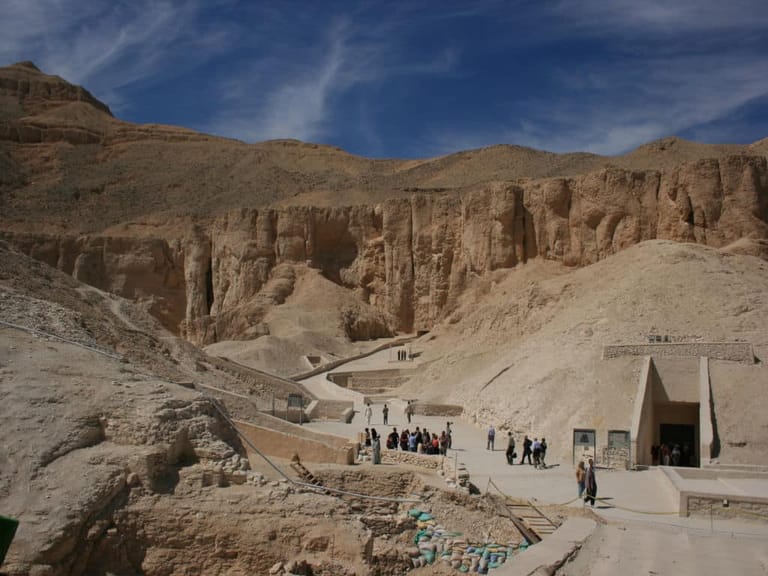
The site for this royal burial ground was selected carefully. Its location on specifically the west side of the Nile is significant as well. Because the sun god set (died) in the western horizon in order to be reborn, rejuvenated, in the eastern horizon, the west thus came to have funerary associations. Ancient Egyptian cemeteries were generally situated on the west bank of the Nile for this reason.
The powerful kings of the New Kingdom were laid to rest under the shadow of a pyramid-shaped peak rising out of the cliffs surrounding the valley. The selection of even the specific valley in which the royal tombs were excavated was not left to chance. The pyramid was a symbol of rebirth and thus eternal life, and the presence of a natural pyramid was seen as a sign of the divine. This entire area, and the peak itself, was sacred to a funerary aspect of the goddess Hathor: the “Mistress of the West”.
(c.1147–1143 BC) of the Twentieth Dynasty. Although it is uncertain whether he was ultimately buried here, it is clear that his uncle Ramesses VI (c.1143–1136 BC) enlarged the tomb and used it for his burial.
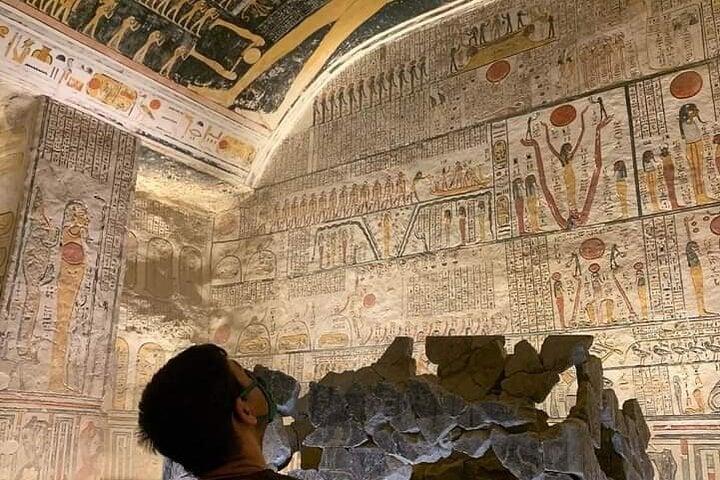
The tomb is simple in plan, essentially consisting of a series of descending corridors that lead deep underground, in a straight line to the burial chamber. The exquisitely painted sunk relief walls are very well preserved.
This tomb has multiple side chambers off the first and second corridors B and C, which are decorated with unusual scenes. Workers cutting this tomb accidentally broke through to KV 10. Room D1 is unique in royal burial sites and provides new insights into Ramesside religious beliefs. Another unique feature is that much of the damaged rear part of the tomb (rooms H to L) was decorated with rows of protective deities and demons who kept watch over the king’s burial and rebirth.
Merenptah was the thirteenth son of Ramses II and his second Great Royal Wife. Due to his father’s very long reign, he ascended the throne at a more advanced age, and ruled for only about 11 years. He was an active king, engaging in a number of military campaigns: he held off a coalition of the Libyans and Sea Peoples that attacked Egypt’s Delta in his fifth regnal year; and put down a rebellion in Nubia. One of the most important artifacts of his time, the “Israel Stela,” contains the first recorded mention of Israel.
KV 8 was Merenptah’s original tomb in the Valley of the Kings, but his mummy was then moved at some point into the tomb of Amenhotep II (KV 35).
The tomb of the Eighteenth Dynasty king Tutankhamun (c.1336–1327 BC) is world-famous because it is the only royal tomb from the Valley of the Kings that was discovered relatively intact. Its discovery in 1922 by Howard Carter made headlines worldwide, and continued to do so as the golden artifacts and other luxurious objects discovered in this tomb were being brought out. The tomb and its treasures are iconic of Egypt, and the discovery of the tomb is still considered one of the most important archaeological discoveries to date.
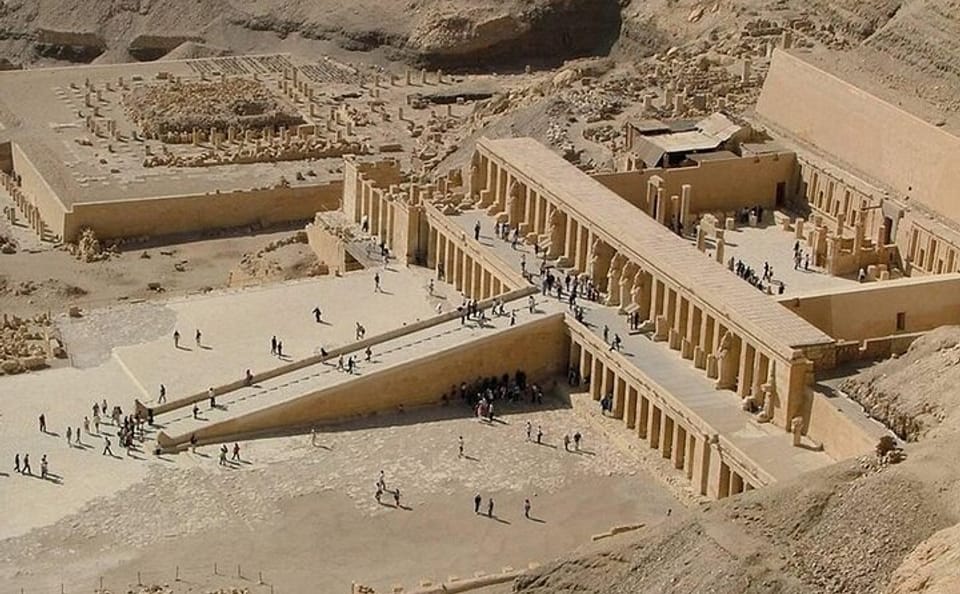
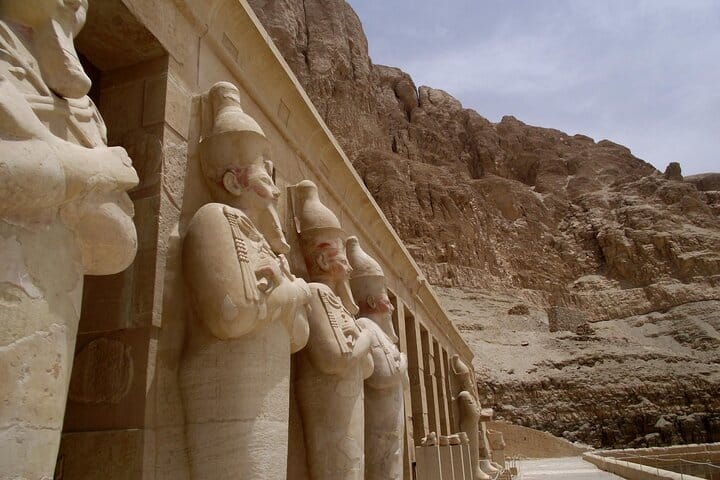
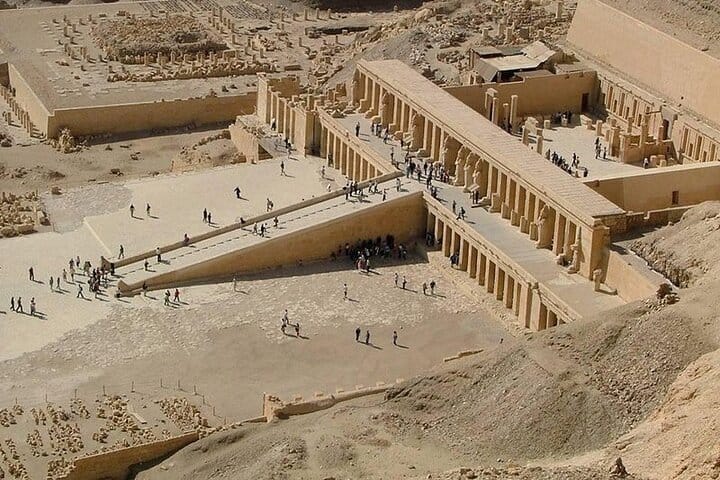
Hatshepsut (c.1473–1458 BC), the queen who became pharaoh, built a magnificent temple at Deir al-Bahari, on the west back of Luxor. It lies directly across the Nile from Karnak Temple, the main sanctuary of the god Amun. Hatshepsut’s temple, Djeser-djeseru “the Holy of Holies” was designed by the chief steward of Amun, Senenmut.
Pharaoh Amenhotep III reigned in Egypt during the 18th Dynasty from 1386 to 1349. During his kingdom, Egypt experienced a time of great prosperity and artistic progress, this era was known as the Old Kingdom. During the Old Kingdom, the architectural work improved tremendously in Egypt, and most of these monuments are still standing today.
Many of these majestic monuments were built during Amenhotep III’s 39 years of reign including the Colossi of Memnon which construction was completed by 1350 BC. The Colossi of Memnon was constructed in front of which once was Amenhotep III’ temple (destroyed by an earthquake soon after its completion). Amenhotep Temple served as a funerary temple to the Pharaoh Amenhotep III. Due to an earthquake at 27 BC the Colossi of Memnon was partially destroyed and then restored by Roman emperors during the Roman Empire in ancient Egypt.
Fully refundable until 1 day before start
Non-refundable after 1 day before start
Elite
Free Cancellation · Instant confirmation · Private tour
 Elite
Elite
Instant confirmation · Meet on location
 Elite
Elite
Free Cancellation · Instant confirmation · Private tour
Free Cancellation · Instant confirmation · Private tour
 Elite
Elite
Free Cancellation · Instant confirmation · Private tour
 Elite
Elite
Free Cancellation · Instant confirmation · Private tour
 Elite
Elite
Free Cancellation · Instant confirmation · Pickup available
 Elite
Elite
Free Cancellation · Instant confirmation · Private tour
Our assistant finds tours and checks live dates and prices, and answers your questions.