Historic Jewish Heritage Tour in Marrakech
Why we love it?
The Historic Jewish Heritage Tour in Marrakech is a three-hour exploration of the city's rich Jewish history and culture. This tour is ideal for history enthusiasts, cultural travelers, and those interested in the diverse narratives that shape Marrakech. Participants will visit significant sites, including synagogues and the historic Mellah, gaining insights into the Jewish community's contributions to Moroccan society. With bottled water provided, guests can comfortably immerse themselves in the unique blend of traditions that define this vibrant city.
Inclusions
- Bottled water
Exclusions
- TIPS
Itinerary
Step 1
the Mellah is a term used to describe an area of residents of Jewish origin. It is generally surrounded by high walls to separate them from other population such as Christians and Muslims.
Since 1438, following the great wave of immigration of Jews from Spain fleeing the persecutions of the Reconquista, several urban mellahs were created on the Moroccan territory. From Fez to Meknès, from Essaouira to Taroudant, from Rabat and Sale, and in Marrakech. The Mellah of Marrakech is considered as one of the largest in Morocco. By its history and geography, it surprises and impresses us until its recent renewal wanted by King Mohamed VI.
Even if the presence of Jews has been documented since the 2nd century, the Jewish Mellah of Marrakech has only been recognized as such since 1558, the date of its creation by the authorities.
Throughout the Middle Ages, the population of the Jewish Mellah of Marrakech was estimated at 70,000 person. At the end of the 18th century, a figure of 35,000 was put forward. In 1936, 15,000 Jews were registered. Since the end of the Second World War and the creation of Israel in 1948, the Jewish population has been steadily decreasing. It now stands at 175 persons. Very few of them live in the original Mellah (less than 10 people), they preferred the comfort of the new city of Marrakech, Gueliz.
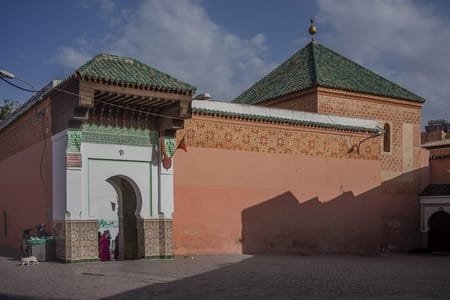
A quadrilateral of more than 18 hectares, the historic mellah is surrounded by large walls with 2 access doors on the outside (bab in Arabic) : one toward the city itself, the other on the cemetery.
The streets, the parallel or perpendicular internal lanes, with its high houses without windows, thebalcony buildings (some of them), however, gave it a certain regularity and homogeneity.
The Mellah was essentially composed of :
-riads (house of living).
-fondouks (or caravansérail : large house centred on an inner courtyard used as commercial warehouses, animal shelters and accommodation for merchants and travellers).
-commercial streets or souk (spices, fabrics, etc.).
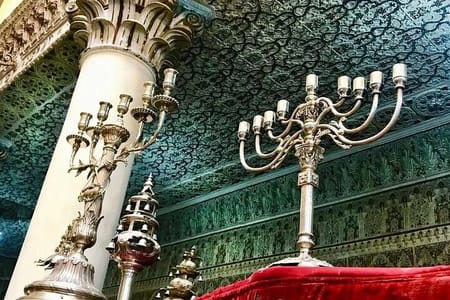
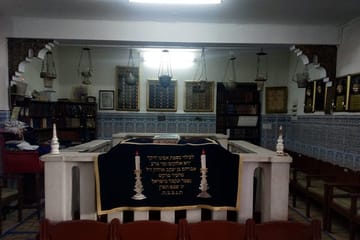
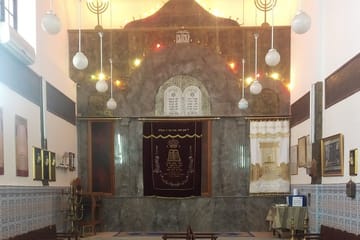
-synagogues (up to thirty enumerated).
-places, more or less large.
The Square des Ferblantiers is the nerve centre of the mellah by day, the door toward the city opening into its centre, with Jewish craftsmen working in tinplate. A tradition that has been maintained since then until the Arabs nowdays. The souk of spices and the souk of jewellery were known and frequented by Muslims since the 16th century.
Step 2
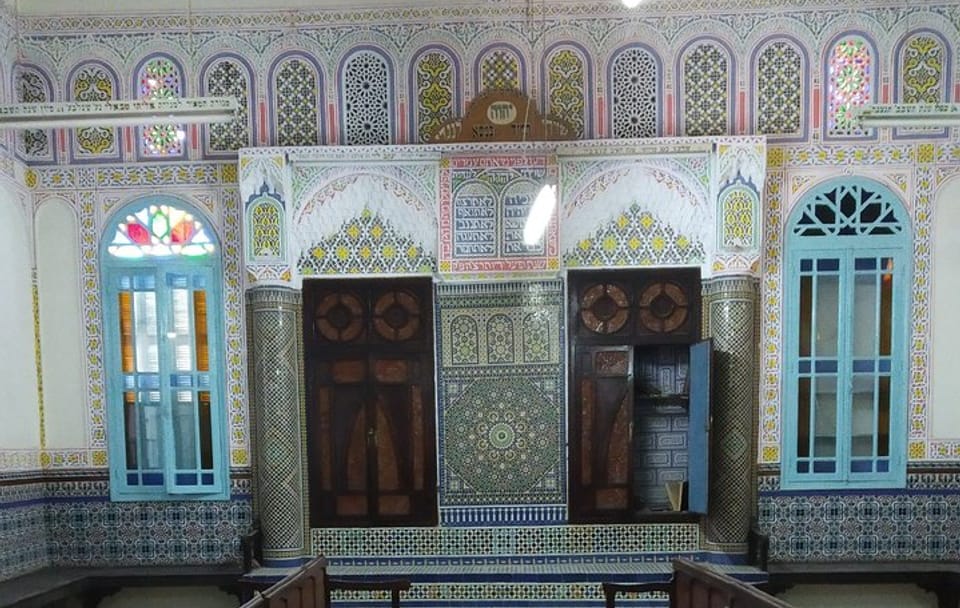
A well-tended courtyard surrounds the Lazama Synagogue. Around the outer edges are curtains offering privacy to the members who live there. Beautiful hand-laid tiles covered many of the walls, often between the curtains.
Colour and patterns reflect the Jewish atmosphere, as does the Hebrew letters along the upper edge of the walls. While mostly blues and white are used in this courtyard.
A mezuzah hangs on the doorframe at the entrance to Lazama Synagogue. A mezuzah is a piece of parchment often in a decorative case. It is inscribed with specified Hebrew verses from the Torah.
Typically, a mezuzah is hung at the door of a Jewish home. In addition, some wear a mezuzah charm around their neck for protection.
Step 3
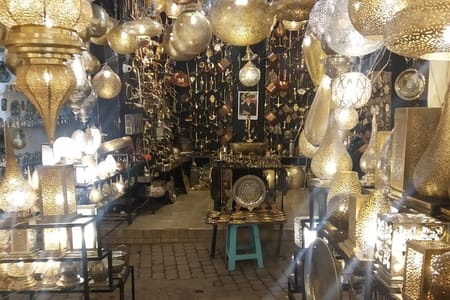
The recently renovated Tinsmiths’ Square (Place des Ferblantiers) overlooks the Badi Palace by an arch, the entrance to the Spice Souk and the Mellah Souk on its left side, and the alley leading to the Bahia Palace. You will find shops, restaurants and snack bars and in a corner some tinsmiths.
The Spice Souk at the entrance of the great souk of the Mellah. You will find all the Moroccan spices, herb and herbal tea merchants, fabric shops to have you make clothes or decorative objects by local craftsmen.
The Kissaria of jewellers and goldsmiths (at the end of the square of the Tinsmiths’ Square, towards the Bahia Palace). Jewish creation taken over by the Muslim population since then, organized around 2 covered galleries. You can admire gold and silver coins, fibulas, Fatima’s hands and other Berber jewellery.
Dating from the 16th century
is the largest Jewish cemetery in Morocco. Divided into 3 distinct edges (men, women, children), it is the only one to be so because of the singular custom (minhaggim) of the Jews of the city of Marrakech.
Please Note
- Wheelchair accessible
- Stroller or pram accessible
- Not suitable for pets
- Not wheelchair accessible
- Wheelchair accessible
Know Before You Go
- Public transportation nearby
- Infants must sit on laps
- Infant seats available
Cancellation Policy
Fully refundable until 1 day before start
Non-refundable after 1 day before start