Marrakech Monuments Heritage & Souks
Why we love it?
The Marrakech Monuments Heritage & Souks tour offers a deep dive into the historical and cultural treasures of Marrakesh over a duration of 3 hours and 30 minutes. Participants will explore iconic sites such as the Koutoubia Mosque, the Dar El Bacha Museum, and the Ben Youssef Madrassa, each showcasing the rich architectural heritage and artistic traditions of Morocco. This tour is well-suited for history enthusiasts and travelers looking to immerse themselves in the vibrant atmosphere of the city's souks while adhering to health guidelines with provided masks for protection against COVID-19. Its distinctive blend of cultural exploration and local craftsmanship makes it a unique experience for those seeking to understand the essence of Marrakesh.
Inclusions
- Masks for protection against COV19
Exclusions
- Tips
- All Fees and Taxes
Itinerary
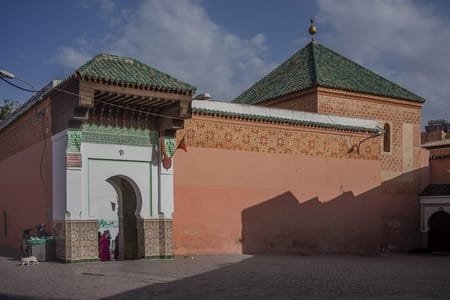
Koutoubia Mosque
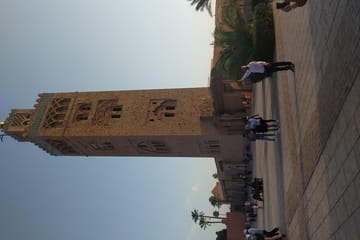
The Koutoubia Mosque was built in 1150 by the Almohad Caliph Yaqub al-Mansur. It was built on the site of an earlier mosque that had been destroyed by an earthquake in 1147. The mosque was originally called “Jama’ al-Koutoubiyyin”, which means “Mosque of the Booksellers”, as it was located near a book market. The mosque was later renamed “Koutoubia”, which is derived from the Arabic word for bookseller.
The [ ] was designed by the famous architect Ahmed Ashakh. He used a unique combination of Islamic and Andalusian architectural styles to create a beautiful and impressive structure. The mosque is built from red sandstone and has a large minaret that stands 77 meters tall. The minaret is decorated with intricate carvings and is topped with a copper globe and crescent moon.
he [ ] is an important symbol for the people of Marrakech. It is a reminder of the city’s rich history and culture, and it is a source of pride for many locals. The mosque is also a popular tourist destination, as it is one of the most impressive and beautiful mosques in Morocco.
The Koutoubia Mosque is also an important religious site for Muslims in Marrakech. It is used for daily prayers and for special religious ceremonies such as weddings and funerals. The mosque also serves as a place of learning, as it houses a library with books on Islamic studies and other topics.
Dar El Bacha Museum
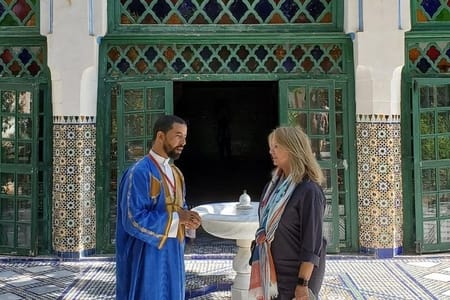
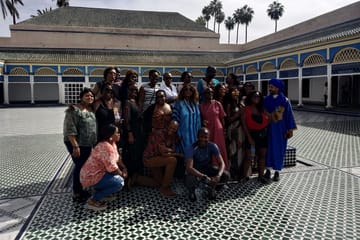
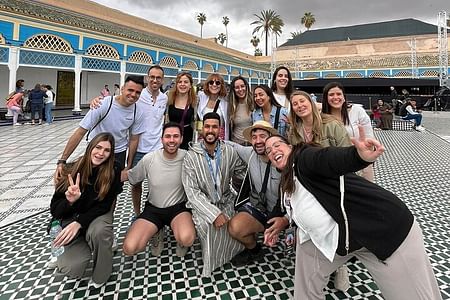
The Dar El Bacha Museum, also known as the Museum of Confluences, is a magnificent historical palace located in the heart of the old medina of Marrakech, Morocco. It stands as a stunning example of Moroccan architecture and craftsmanship, serving as a window into the city's opulent past and vibrant cultural heritage.
Built in the early 20th century, around 1910, Dar El Bacha translates to "House of the Pasha." It was the palatial residence of Thami El Glaoui, the powerful Pasha of Marrakech who held significant political sway under the French Protectorate from 1912 to 1956. Known as the "Lord of the Atlas," El Glaoui built this grand palace to impress and entertain distinguished guests, hosting world-renowned figures such as Winston Churchill, Charlie Chaplin, and Franklin D. Roosevelt.
Architecture & Design
Dar El Bacha is celebrated as one of the finest examples of traditional riad architecture in Marrakech. Its design is a testament to the skill of Moroccan artisans, featuring a harmonious blend of Andalusian and Islamic influences with subtle European touches. Key architectural features include:
- Central Courtyard: The heart of the palace is a lush, symmetrical courtyard garden filled with orange trees and fountains, offering a tranquil escape from the bustling medina.
- Intricate Decoration: Every surface is adorned with exquisite detail. Visitors can marvel at colorful zellige (geometric mosaic tilework) covering floors, walls, and columns, alongside intricately carved and painted cedar wood ceilings and doors.
- Plasterwork: The walls feature elaborate white stucco carvings with geometric and floral patterns.
- Hammam: The palace includes a beautifully preserved traditional hammam (bathhouse). Its original subterranean brick heating system is visible beneath glass floor panels.
- Museum Collections & Features
As the Museum of Confluences, the palace now hosts exhibitions that celebrate the rich tapestry of Moroccan identity and culture.
Exhibitions: The museum features rotating temporary exhibits that explore various aspects of Moroccan art, history, and archaeology. Permanent collections include objects related to Islamic science and knowledge, highlighting the country's diverse cultural influences.
Bacha Coffee: Inside the museum's courtyard is the famous Bacha Coffee House. This opulent, period-style cafe is a destination in itself, offering an extensive selection of 100% Arabica coffees from around the world in a glamorous setting reminiscent of the palace's heyday.
Ben Youssef Madrassa
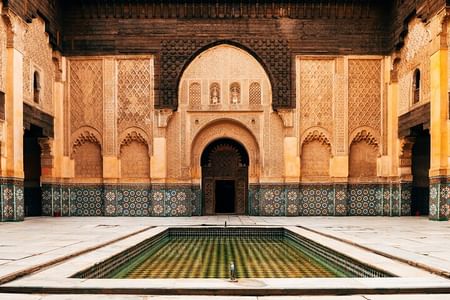
The Ben Youssef Madrasa is one of the most significant and beautiful historical monuments in Marrakesh. Located in the heart of the Medina, this 16th-century Islamic college is a masterpiece of Moroccan architecture and was once the largest madrasa in North Africa.
The Early Foundation (Almoravid and Marinid Periods)
12th Century: The original site of the madrasa is next to the Ben Youssef Mosque, which was founded by the Almoravid Sultan Ali ibn Yusuf (r. 1106–1142 CE)—the city's second ruler. The madrasa is named in his honor.
14th Century: The first formal Islamic college on this site was established during the Marinid dynasty, a period known for the expansion of education, arts, and literature across Morocco.
2. The Saadian Masterpiece (16th Century)
Current Structure: The famous, elaborate building you see today was commissioned by the Saadian Sultan Abdallah al-Ghalib in the mid-16th century, replacing the older Marinid structure.
Completion: The construction was completed in 1564–1565 CE.
Status and Capacity: Upon its completion, it was the largest madrasa in the Maghreb (North Africa). It was designed to house upwards of 800 to 900 students from across the Muslim world in its 130 small dormitory cells.
Function: For four centuries, the madrasa was a major intellectual hub, dedicated primarily to the study of Islamic theology, law, and other sciences.
Souks
Sensory Overload and Atmosphere
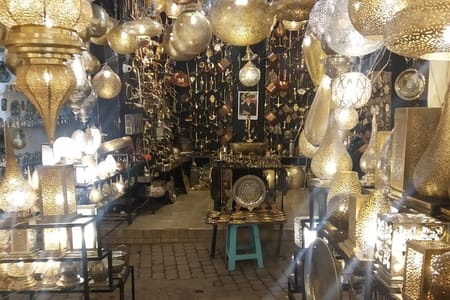
Sight: The souks are an explosion of color. You'll see bright mounds of spices, towering displays of intricately patterned ceramics and tagines, rainbow-hued textiles and hand-dyed wool hanging to dry, and the warm glow of countless metal lanterns.
Sound: It's a place of controlled chaos. The air is filled with the rhythmic hammering of the coppersmiths, the cheerful calls of vendors, the buzzing of motorbikes navigating the narrow lanes, and the lively bartering between shoppers and sellers.
Scent: Intoxicating aromas permeate the air—a mix of fragrant spices like saffron and cumin, fresh leather, cedarwood, essential oils, and mint tea.
Feeling: Navigating the souks is an immersive, almost overwhelming experience. It is a dense, high-energy environment that pulses with centuries of Moroccan culture and trade tradition.
Souk Haddadine (Blacksmiths): The realm of metalworkers, where you can see artisans shaping iron and copper to create lamps, gates, and utensils.
Souk Cherratine (Leather Workers): Features leather goods like bags, belts, and the famous babouches (traditional Moroccan slippers).
Souk des Teinturiers (Dyers' Souk): Famous for brightly colored skeins of wool and fabrics hung high to dry, creating a vivid canopy.
Souk Smata (Slippers): An area dedicated almost exclusively to the colorful, embroidered, and pointed Moroccan slippers.
Le Jardin Secret
The Secret Garden has a rich and dramatic history spanning centuries.
Origins in the Saadian Era (16th Century)
First Palace: The origins of the property date back to the second half of the 16th century during the Saadian Dynasty (1510–1659 ACE). Sultan Moulay 'Abd-Allah initiated the urbanization of the Mouassine district, and a grand palace was first built on this land.
Destruction: Like many significant buildings of the Saadian period, this palace was destroyed towards the end of the 17th century after the decline of the dynasty.
The Palace of the Caid (19th Century)
Reconstruction: Towards the middle of the 19th century, a new palace was constructed on the same grounds by the Caïd (local chief) al-Hajj 'Abd-Allah U-Bihi. The new complex respectfully followed the original Saadian layout. This was a period of substantial development in Marrakesh, favoring the construction of rich mansions and gardens.
Political Intrigue: Caïd U-Bihi, however, was viewed with suspicion by the ruling Sultan Muhammad IV and was eventually killed with poisoned tea.
Succession of Owners: The property then passed through the hands of prominent political figures, including the great judge Moulay Mustapha.
The Last Private Owner (Early 20th Century)
Loukrissi: In 1912, the palace was acquired by al-Hajj Muhammad Loukrissi, a former head of the watchmakers' guild and the Chamberlain of Sultan Moulay 'Abd-al-Hafiz. When the Sultan was exiled, Loukrissi moved into the palace and lived there until his death in 1934.
Decline and Restoration
Disrepair: After Loukrissi's death, the property ceased to be properly maintained and fell into a state of severe disrepair, eventually becoming a hidden maze of neglected dwellings within the high walls.
The Vision: The idea to restore the forgotten riad and open it to the public took root around 2008 and the site was purchased by two Italian partners, Lauro Milan and Sante Giovanni Albonetti.
Restoration: The meticulous restoration began in earnest, respecting the historical and cultural significance of the space. It involved skilled Moroccan artisans.
Garden Design: The modern garden design was overseen by the renowned British landscape designer Tom Stuart-Smith, who created the two distinct courtyards you see today: the traditional Islamic Garden and the Exotic Garden.
Architectural & Cultural Details
Water System (Khettara): A significant discovery during the restoration was the ancient khettara, an underground irrigation gallery built by the Almoravids in the 11th century to bring water from the High Atlas Mountains to the city. The Secret Garden was once supplied by this rare and privileged system.
Islamic Garden Design: The larger garden is laid out in the chahar bagh (four-fold) design, a symbolic arrangement that reflects the Quranic descriptions of Jannah (paradise/garden), emphasizing order, symmetry, and the importance of water.
Please Note
- Wheelchair accessible
- Not stroller accessible
- Not suitable for pets
- Not wheelchair accessible
Know Before You Go
- Public transportation nearby
- Infants must sit on laps
- Infant seats available
Cancellation Policy
Fully refundable until 1 day before start
Non-refundable after 1 day before start