

Osaka Castle Walking Tour
Free Cancellation · Instant confirmation · Meet on location

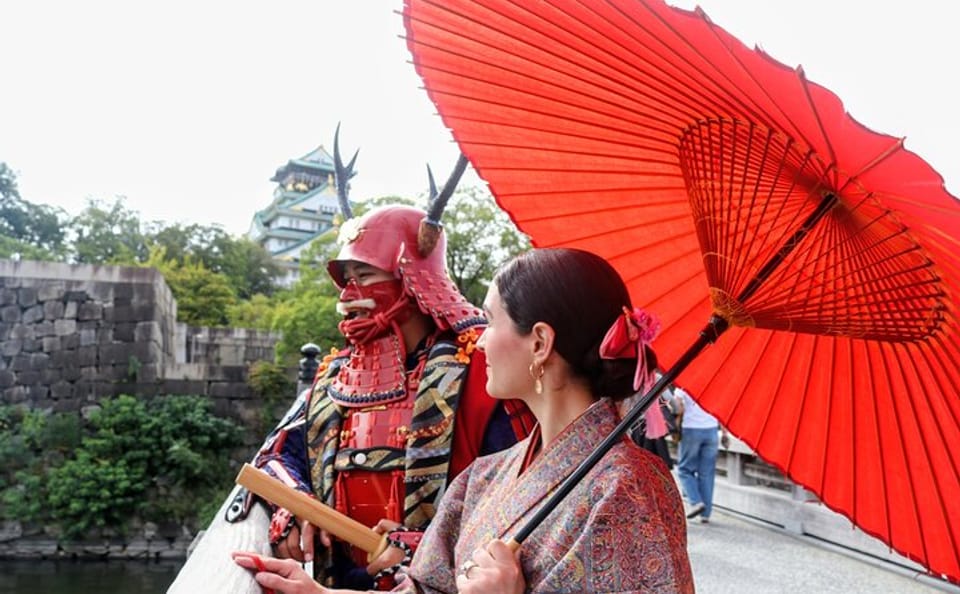
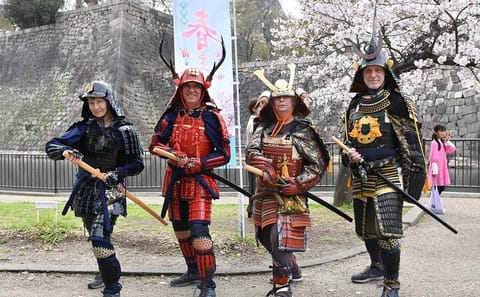
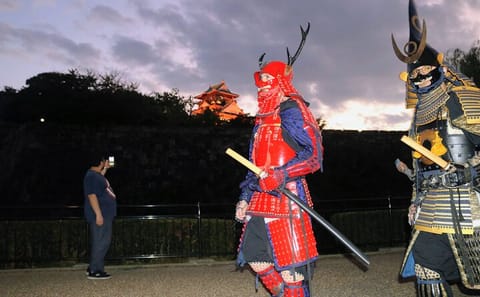
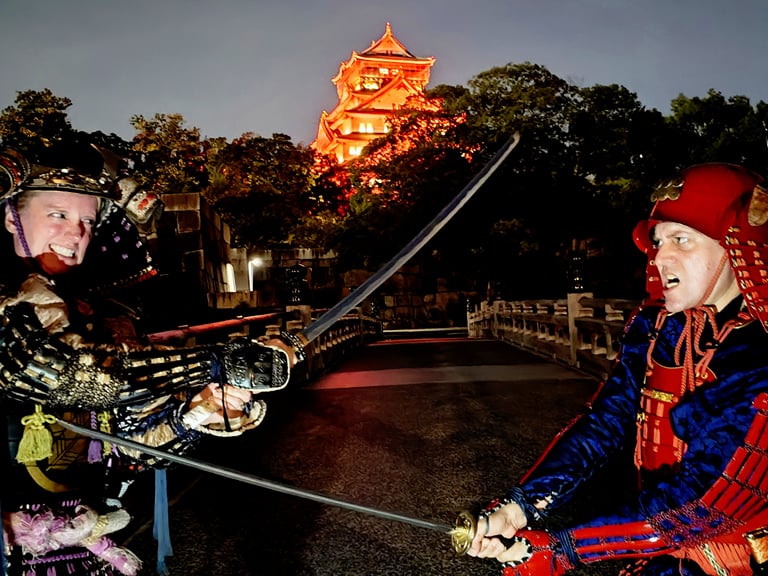
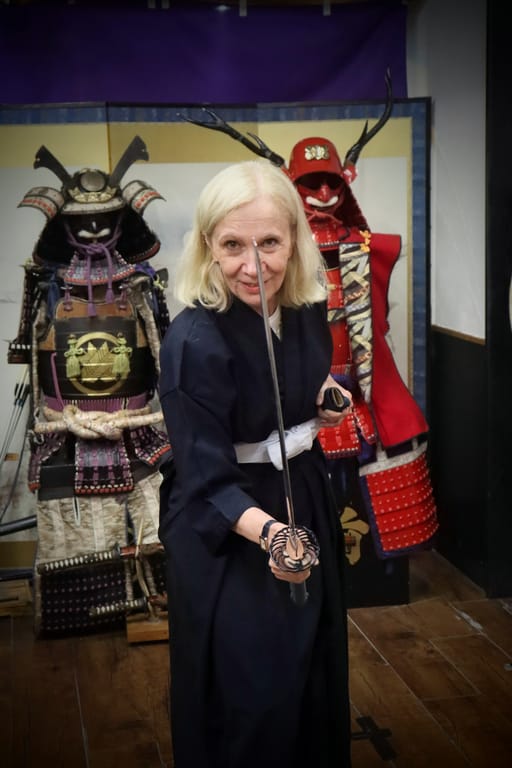
Don the armor that symbolizes the samurai
A professional will assist you every step of the way as you put on the heavy armor.
After the winter campaign in Osaka, Ieyasu devised a strategy against the Toyotomi side and included in the terms of the peace agreement the reclamation of the moat. In this way, not only the outer moat but also the inner moat, Ninomaru and Sannomaru, were reclaimed. And after stripping Osaka Castle...Osaka Natsu no Jin⚔ begins the war.
Osaka Castle has four entrances and exits. One of them is Aoyamon. The gate in the square there is called Aoyamon. You may think it is an important cultural property because of its magnificent Aoyamon, but unfortunately it is not, as it was restored.
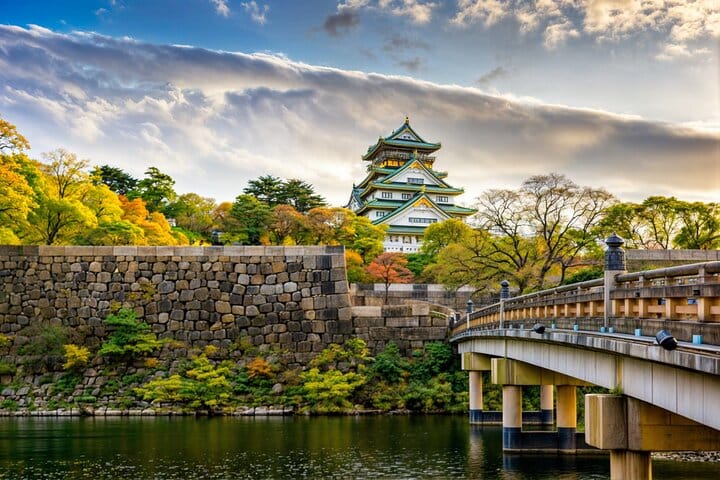
From this prime vantage point at Aoya Gate, where you can see the Honmaru up close, take a moment to admire the towering figure of the main keep. To ascend to the Honmaru from Aoya Gate, you must cross a bridge called Gokuraku Bridge.
The stone wall next to the Aoya Gate is the perfect spot for taking photos, offering a close-up view of the Honmaru—including the Yamazato Bailey. Climb up to the top of the stone wall via the stairs inside the Ninomaru, and frame the castle tower—which stands tall on the hilltop of the Honmaru—through a gap in the trees; this will help convey the tower’s impressive height. We especially recommend taking photos in the morning when the sun is shining on the east side of the stone wall.
The inner moat of Osaka Castle is a massive moat built to encircle the Honmaru. The stone walls surrounding the Honmaru, which tower on either side of the moat, feature massive boulders and engraved inscriptions, making this a popular spot for a stroll where visitors can feel the weight of history.
Gokurakubashi" as a bridge to the Paradise
During the Osaka Summer Battle, Toyotomi Hideyori, the lord of Osaka Castle, and his mother, Yodo-dono, committed suicide immediately after the castle fell. A monument that is believed to be the place of their suicide is located in this vicinity.
In the Yamazato-maru (Yamazato Bailey) of Osaka Castle stands the “Memorial Tower for Lady Yodo and the 32 Retainers Who Died by Their Side” (where the sacred Kannon Bodhisattva is enshrined), erected to honor the retainers who died alongside Toyotomi.
The daimyo of 69 Japanese domains provided stones for the construction of Osaka Castle, and the stone walls bear the seals and patterns of each domain.
It is believed to have been a bailey used to hide soldiers when the castle was under attack.
The Uemachi Plateau, where Osaka Castle is located, is at a high elevation, and because the ground on the south side is elevated, water cannot accumulate there; therefore, it was constructed as a dry moat from the very beginning.
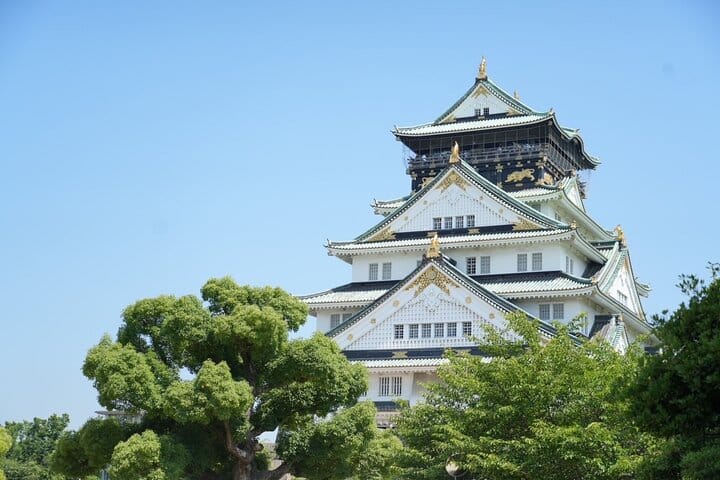
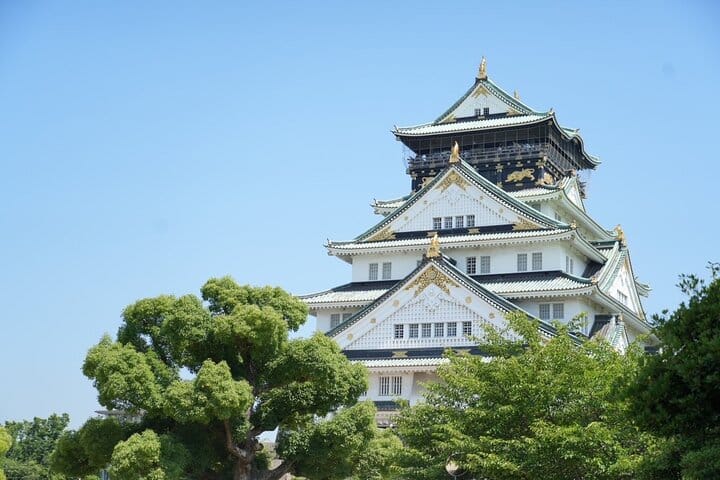
Osaka Castle is the most difficult castle to attack, built by Toyotomi Hideyoshi, who aimed to unify the country. It is 55 meters above the ground, with five levels and eight stories. The golden ornamentation everywhere shines brilliantly, including the ornate ornamentation of the shachi on the topmost roof and the fushitora (tiger) under the kagaran (columns). It is known as a representative example of castle architecture that rises dignifiedly against the blue sky. Note: Entry into the castle keep is not included.
In 1931 (Showa 6), in conjunction with the reconstruction of Osaka Castle's castle tower, this purely Japanese-style garden was developed by the city of Osaka as the garden of Kishu Palace, which was built on the east side at the time. The central pond has an area of 300 tsubo (300 tsubo) in the shape of a crane wing, with a rocky mountain in the background. From the south side of the pond, the garden has been designed so that you can enjoy the view of the castle tower.
The “Takoiishi” at Osaka Castle is the largest boulder within the castle grounds, boasting the greatest surface area among the castle’s stone walls. Dimensions: Surface area approximately 59.43 square meters (equivalent to about 36 tatami mats)
Height: 5.5 meters
Width: 11.7 meters
Thickness: Approximately 75 centimeters
Weight: Approximately 108 metric tons
Mysterious Legend: There is a legend that “when it rains, the silhouette of an octopus appears on its surface,” but this phenomenon has not been observed to date.
[16 guns and horizontal arrows]
Teppo-Haza has 16 guns in total, 8 with Kasaishi crenels and 8 with maruhasama on the earthen wall (of which 2 are on each Kasaishi crenel on the top of the megalith). Originally, there was a tamon turret on the stone walls on both sides of the earthen wall, and on the left side of the earthen bridge there was a kuruwa where a horizontal arrow could be hung. View of Sakuramon Dobashi Bridge from Yokoyakake Point of Sakuramon Gate. Every earthen bridge in Osaka Castle always has a crossbar.
This shrine is located in front of Osaka Castle's Sakura Gate and is dedicated to Lord Toyotomi Hideyoshi, Lord Toyotomi Hideyori, and Lord Toyotomi Hidenaga. The ruins of Osaka Castle are where the followers of Ishiyama Honganji Temple fought against Oda Nobunaga's onslaught for 11 years during the famous Battle of Ishiyama. The area was so fortified that even Nobunaga gave up on conquering it and made peace with it, so Hideyoshi chose this area to pacify the country and build his castle, and is said to have the closest connection to the enshrined deity. It is considered to be the perfect sacred area for worship.
Amid the bitter cold, plum blossoms bloom before all other flowers, exuding a delicate fragrance. Their charming allure is a quintessentially Japanese aesthetic that gently envelops the Japanese sensibility, yet
Samurai honor's Shop
Fully refundable until 1 day before start
Free Cancellation · Instant confirmation · Meet on location
Free Cancellation · Instant confirmation · Private tour
Free Cancellation · Instant confirmation · Meet on location
Free Cancellation · Instant confirmation · Private tour
Free Cancellation · Instant confirmation · Min age 12+
Free Cancellation · Instant confirmation · Meet on location
Free Cancellation · Instant confirmation · Private tour
Cancellable until 1 day before · Instant confirmation · Meet on location
Our assistant finds tours and checks live dates and prices, and answers your questions.