
Marrakech Souks & Hidden Gems Walking Tour
Why we love it?
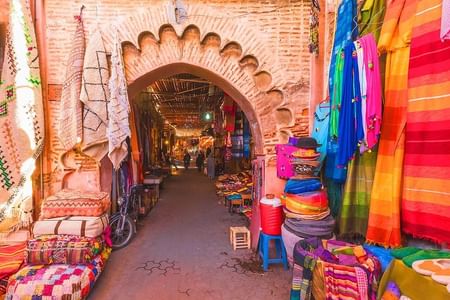
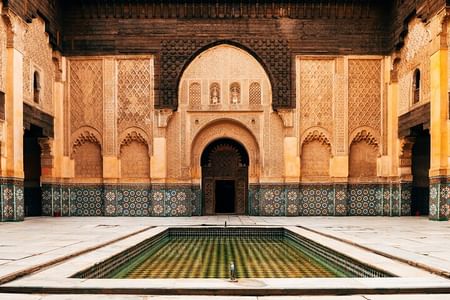
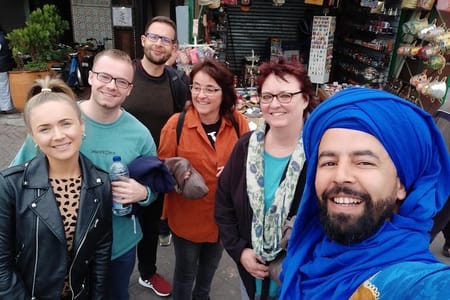
The Marrakech Souks & Hidden Gems Walking Tour offers participants an immersive experience through the vibrant streets of Marrakesh, lasting 3 hours and 30 minutes. This tour is ideal for travelers seeking to explore the city's rich cultural tapestry, particularly those interested in traditional crafts and local heritage. Highlights include visits to the Tanneries and the dyers market, where visitors can witness the intricate processes behind Morocco’s renowned textile industry. Additionally, the tour features a stop at the highest rooftop for a refreshing mint tea, providing stunning views of the city and an opportunity to appreciate the beauty of Marrakesh from above.
Inclusions
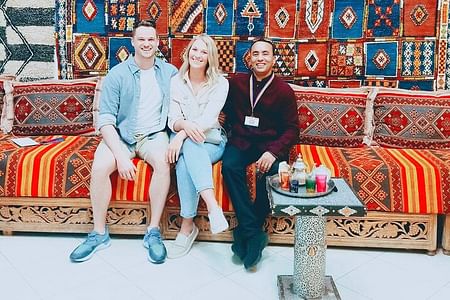
- Drink a mint tea at the highest roof top to admir Marrakech beauty.
Itinerary
The Tanneries
The traditional process for tanning leather is undoubtedly smelly, yet this smell is a small price to pay for witnessing such a unique and interesting interesting sight.; where else would you get the chance to see the men tread and rinse skins in mysterious liquids and dyes before scraping and stretching the hides using traditional techniques.
Step 1 – Iferd
The traditional process of tanning leather, as witnessed in the Marrakech Tanneries, begins with soaking the skins in a fermented solution of pigeon poo and tannery waste, known as iferd. The hide ferments I the iferd for 3 day in the summer and up to 6 days in the winter before they are squeezed out and left to dry. The process of tanning skins is symbolic: according to tanners, this first step of the tanning process is where the skin eats, drinks and sleeps before being ‘reborn’ from the water.
Step 2 – Lime and Argan-kernel pits
After fermenting in the iferd, the skins are squeezed out and put to dry. Hair is scraped off before the skins go into a pit of lime and argan-kernel ash. This is a good example of how Moroccan society functions as an economical, environmentally friendly society, making sure very little goes to waste and reusing byproducts of other industries. This lime and argan-kernel both lasts 15-20 days in the summer and 30 in the winter, working to remove any remaining flesh and hair to prepare the skin for the tanning products.
Step 3 – Qasriya
After being washed, the skins spend 24 hours in a qasriya, a round pit of ye more pigeon poo and water. At this stage the skin becomes thinner and stretcher. At this qasriya stage, the skin is said to receive naks, a spirit.
tep 4 – The Tanning process begins
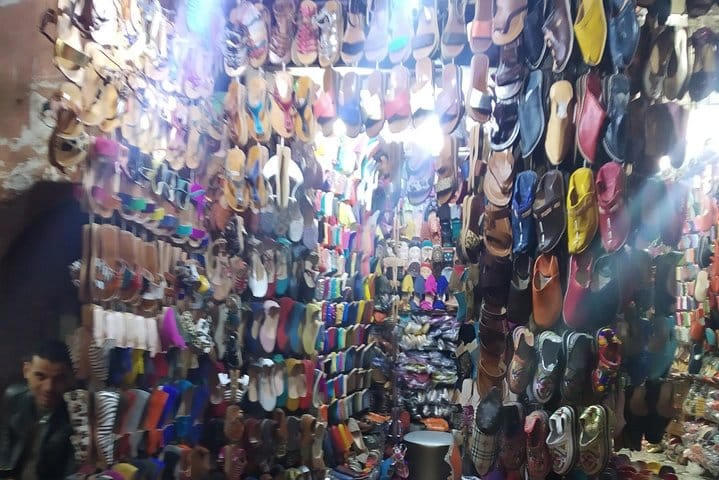
Then begins the actual tanning process. The skins are scraped with pottery shards and beaten with alum, oil and water in preparation to receive the dye. Traditional tanners only ever use plants to dye their leather – that is, roots, bark, seeds and fruits. The solution depends on the type of hide used – cow, camel, goat, sheep – and the colour the leather will be dyed. For example, the infamous yellow babouche is traditionally made using pomegranates!! The dye is a applied by hand, as it has always been, before the skin is left to dry out in the hot Moroccan sun.
Step 5 – A Smooth Finish
Finally, the skins are repeatedly stretched between two ropes to make them smoother and more flexible. This traditional process is difficult work and is only carried out by the younger, more able-bodied men. This treading stage is said to give the skin life again and thus leather is born to be created into handcrafted thus leather products including travel bags and satchels, poofs, babouche slippers and more.
The dyers market in marrakech
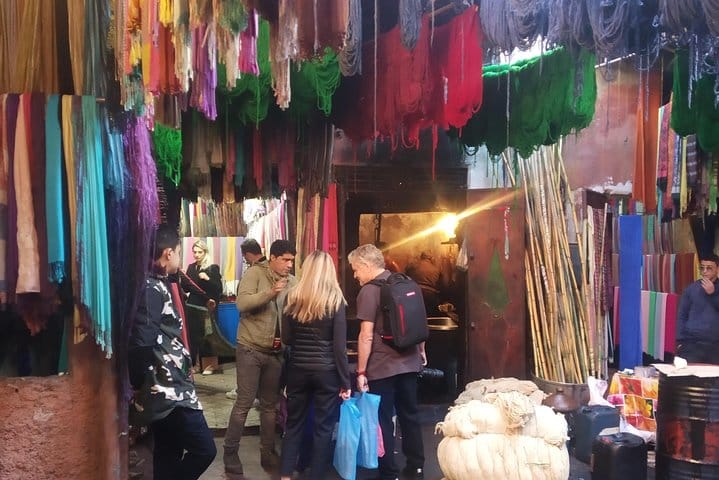
For more than a hundred years, the dyers have worked hard (with the exception of Friday) to produce wonderful pigments from natural vegetable and mineral dyes such as woad, indigo, saffron, cochineal and sandalwood.
From as early as sunrise, these wizards of tincture gather around large cauldron-like vats; they spend their days working with a multitude of textiles, from leather to silk.
If you ask, one of the artisans will be more than happy to demonstrate the basics of the dying process for you, which is wonderful to behold.
Perhaps one of the most beautiful things to note about the dying process, is how it hasn’t changed over the years. From start to finish, the process is largely manual and organic; which is to this day the most effective and gentle way to treat the textiles.
If you stand still and observe, you may realise the ways in which the souk and what it delivers is changing and modernising; but these historical techniques remain untouched. There’s no cheating and cutting corners when it comes to this trade. This is something that you will see reflected in much of the skilled trade within the souks, as to practice an art for a living is something which is very valued and respected.
There is an old saying in Morocco, relating to skilled trade … “A skilled trade pays you in three ways; It will make you rich, but if it doesn’t make you rich then it will pay your way, but if it doesn’t pay your way then it will give you a long and healthy life”.
Amazigh women heritage Rugs
The art of the carpet expresses itself in Morocco in the expert hands of women and forms a constituent element of the identity of the country, its culture and its know-how. The practice of carpet weaving dates back to nearly 2,200 years ago and is said to have originated in rural communities in the Middle Atlas Mountains and around Marrakech. At that time, these populations were nomadic. The women therefore took advantage of each stopover to make the fabrics of mattresses and blankets, with the wool of the animals of their herd, sheep or goats. Proud of their freedom, these craftswomen never used a model. They wove according to their own inspiration, making each carpet a unique creation.
The weaving of the imagination of Amazigh women
These carpets present themselves as a mirror of the inner world of Amazigh women, as books filled with signs and symbols that make us travel through time. One finds there indeed the characteristic patterns of rock art and primitive artefacts of our humanity.
Other signs are reminiscent of motifs found in Europe during prehistory or in the East and elsewhere around the Mediterranean. A whole geometrical language tells us about women's bodies or sexual organs echoing the permanent wish for fertility. The woman weaver speaks of herself in her virginity, her position as a wife, her pregnancy and her childbirth.
The carpet affirms the identity of the Amazigh tribes
The Amazigh carpet differs according to the tribes where it is made. The carpets of the confederation of the Ait Ouaouzguite tribes, in the region of Taznakhte, near Ouarzazate, are the best known. We find the Glaoua carpet of the High Atlas regions, the carpets of the Middle Atlas, called Achdif, around Meknes and Rabat with the Zemmour or Zayane tribes, and finally, the rural carpet of the Haouz of Marrakech. tribes
The Amazigh carpet differs according to the tribes where it is made. The carpets of the confederation of the Ait Ouaouzguite tribes, in the region of Taznakhte, near Ouarzazate, are the best known. We find the Glaoua carpet of the High Atlas regions, the carpets of the Middle Atlas, called Achdif, around Meknes and Rabat with the Zemmour or Zayane tribes, and finally, the rural carpet of the Haouz of Marrakech.
Djemaa Elfna square
Djemaa el-Fna Square has a rich, sometimes tumultuous history, dating back to the founding of Marrakesh by the Almoravids in the 11th century.
A Name with Mysterious Origins: The name "Djemaa el-Fna" is often translated as "Assembly of the Dead," either referring to the public executions that once took place there or to the failure to complete a mosque project in the 17th century, in which case the square took on the meaning of "mosque of ruins" or "annihilated mosque" (Source: UNESCO, History).
World Heritage Status: Its UNESCO status attests to its essential role in preserving ancestral traditions, particularly the arts of storytelling, Gnawa music, and street theater (halka).
Strategic Location: It is located southwest of the Medina (the historic old city) and serves as a gateway to Marrakesh’s famous souks, all while being overlooked by the minaret of the Koutoubia Mosque.
Please Note
- Not wheelchair accessible
- Not stroller accessible
- Not suitable for pets
- Infants must not sit on laps
- Infant seats unavailable
Know Before You Go
- Public transportation nearby
Cancellation Policy
Fully refundable until 1 day before start
Non-refundable after 1 day before start