
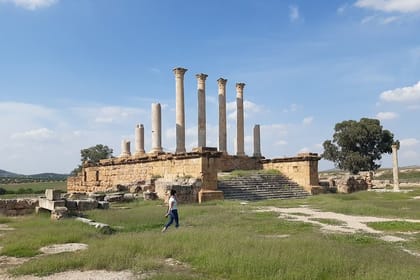

Zaghouan Aqueduct Thuburbo Majus & Uthina Daytrip from Tunis
Why we love it?
The Zaghouan Aqueduct, along with the ancient sites of Thuburbo Majus and Uthina, offers a fascinating day trip from Tunis, lasting approximately seven hours. This experience is ideal for history enthusiasts and those interested in Roman architecture, as it showcases the impressive engineering of the aqueduct that once supplied water to Carthage. The tour includes private transportation in an air-conditioned vehicle with WiFi, allowing for a comfortable journey while exploring these remarkable archaeological sites. Visitors will gain insight into Tunisia's rich history and the significance of these ancient ruins in the context of Roman civilization.
Inclusions
- All Fees and Taxes
- Private transportation
- Air-conditioned vehicle
- WiFi on board
Exclusions
- Lunch
Itinerary
Step 1
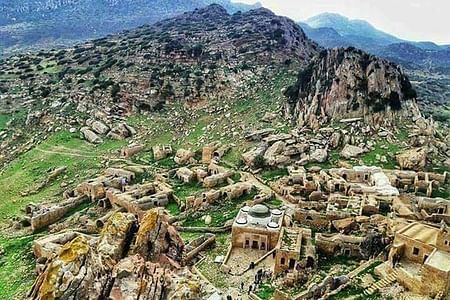
The ancient city of Uthina is located about 30 km south of the capital, at the place known as Oudhna, at the summit of an eminence which dominates the main access routes to Carthage coming from the south and the West of the country. Its foundation seems to date back to the Berber era as evidenced by its toponymy. As history fluctuated, it was punished and then romanized, before the two brief vandal and Byzantine guardianships - nearly a century each prelude to a definitive decline after the Arab conquest in the 7th century.
The backed-up site extends over a hundred hectares. It is 'capitonée' of imposing buildings going back to the Roman time and currently in the course of clearing and consolidation. These are the capitol, the largest in Africa, arranged on three levels; Two groups of very high capacity tanks; Large public baths and small private baths; The remains of patrician residences, an amphitheater with an initial capacity of more than 10,000 spectators.
It's a Roman aqueduct
which supplied the city of Carthage with water, measured 132 km! The Zaghouan-Carthage hydraulic complex is the largest of its kind ever built.
Built at the beginning of the 2nd century AD, the Zaghouan aqueduct testifies to the Romans' mastery of water supply techniques. It crosses a rugged landscape. Sometimes flush with the ground, sometimes underground, the pipeline is, on two portions, raised by arcades sometimes reaching more than 20 meters in height. Its flow has been estimated at around thirty million liters per day.
Most of the water was stored in the gigantic vaulted reservoirs visible at Maalga, at the entrance to Carthage, before supplying the Baths of Antonine.
Step 3
Zaghouan is a city in the northeast, the capital of the governorate of the same name, located 50 km from Tunis. Established on the slope of Djebel Zaghouan, it overlooks a vast agricultural plain
At the site of ancient Ziqua, of which only a triumphal door remains, Zaghouan is a town with steep streets cut off by small squares offering views of the plain. The city, which has about 16,000 inhabitants, is known for its roses, especially the rose hips, which were cultivated by Andalusian Muslims driven from Spain in the 17th century during the Reconquista.
A region renowned for its sources (elders), Zaghouan, attracts both Tunisians and tourists from the Arab world for its hammams.
Step 4
The ancient city of Thuburbo Majus was founded on the side of a hill, surrounded by a splendid fertile valley landscape, long before North Africa became part of the Roman Empire.
However, it is its magnificent remains from the Roman era that make it one of the most beautiful archaeological sites in Tunisia.
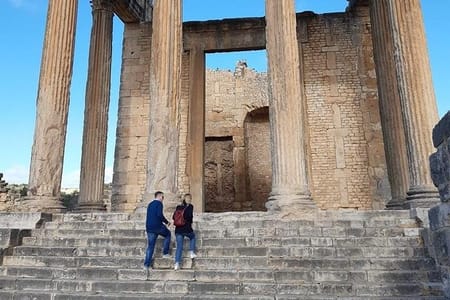
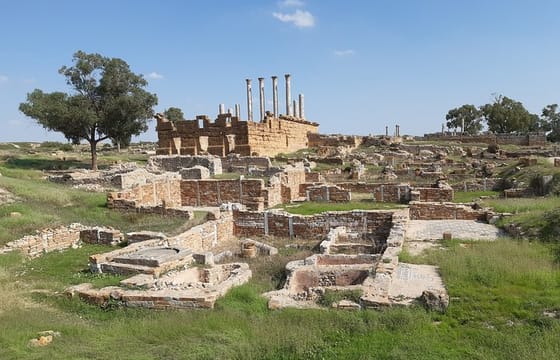
Its Capitol - the most important temple in Roman cities - is one of the best-preserved in Tunisia.
Six elegant Corinthian columns formed the facade. Four are still intact and overlook a wide staircase overlooking the Forum.
One of the original features of Thuburbo Majus was that it had two bathing establishments: one for winter and the other for summer. The summer thermal baths were completed by a sports field, surrounded by a beautiful covered gallery, called Palestre des Petronii after the Roman family who had built the monument.
Another peculiarity of the site is that it has preserved vestiges reminiscent of its pre-Roman past as “temple of Caelestis” or the “temple of Baalat”.
Please Note
- Wheelchair accessible
- Stroller or pram accessible
- Infants must not sit on laps
- Wheelchair accessible
- pick-up from any hotels or Airbnb around Tunis
Know Before You Go
- Animals or pets allowed
- Public transportation nearby
- Infant seats available
Cancellation Policy
Fully refundable until 1 day before start
Non-refundable after 1 day before start