

Beijing is world-renowned for its millennia-old historic sites, from the majestic Forbidden City and serene Summer Palace to the dramatic stretches of the Great Wall. Amid this ancient grandeur, Beijing’s skyline also features striking modern architecture. One of the most captivating examples is the New CCTV Tower, officially the CCTV Headquarters (now part of the China Media Group Headquarters). With its bold geometry and futuristic look, this building contrasts sharply with the city’s imperial past and has become a contemporary architectural icon.
A Futuristic Building in an Ancient Capital
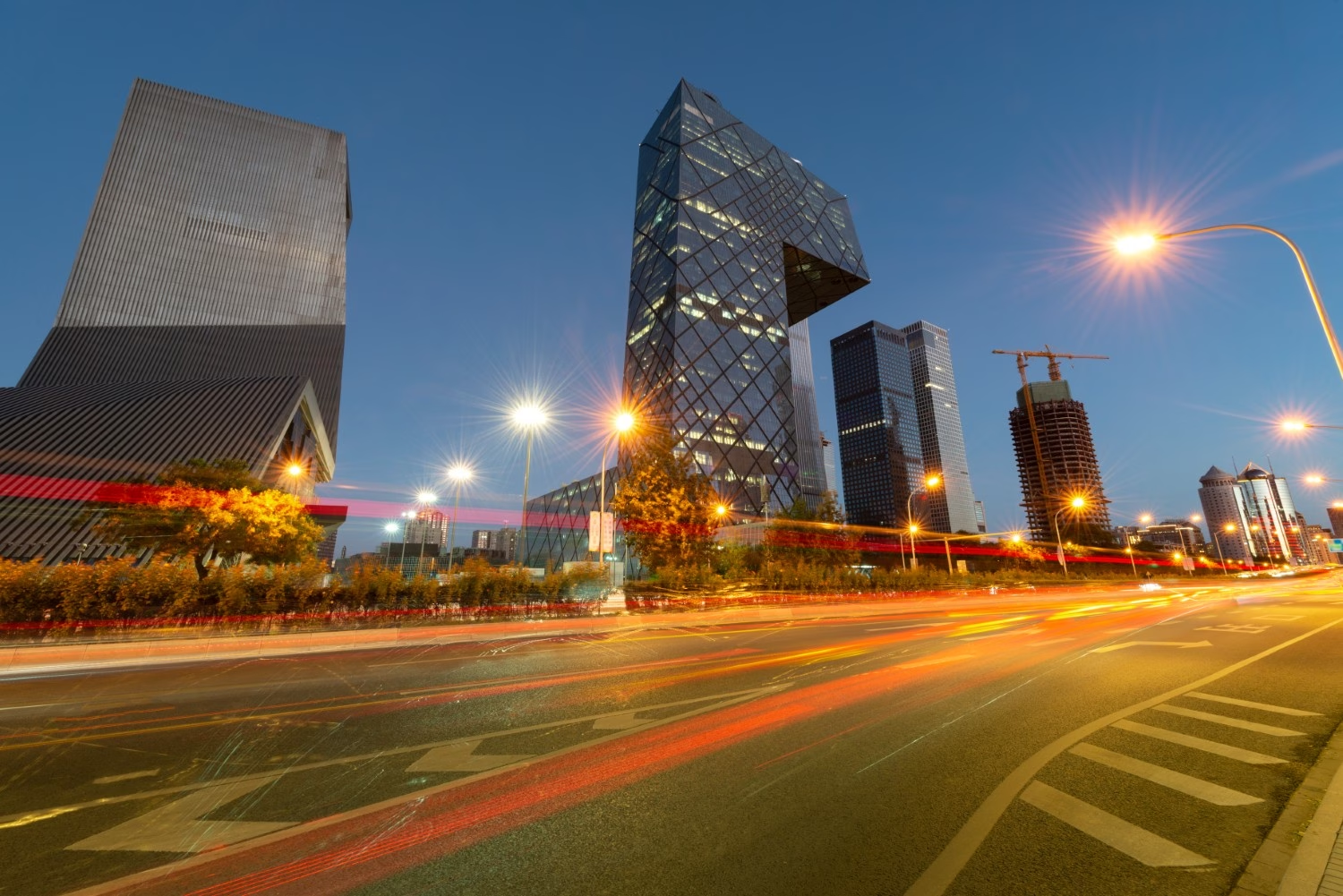
Soaring to 234 meters (768 feet) with 51 floors, the New CCTV Tower dominates Beijing’s Central Business District. Its gleaming exterior reflects sunlight so sharply that it can be blinding. The tower’s form defies traditional skyscraper design. Instead of a standard vertical column, it twists into a continuous loop, forming an enormous, irregular arch or rotated rectangle. Locals affectionately call it “Big Pants” (大裤衩, dà kùchǎ) due to its resemblance to a giant pair of trousers.
This futuristic aesthetic embodies Beijing’s modern ambitions. Built during the city’s construction surge ahead of the 2008 Olympics, alongside avant-garde structures like the Bird’s Nest Stadium and the Water Cube, the tower was intended to showcase a bold, forward-thinking image. Located at East Third Ring Road and Guanghua Road in Chaoyang District, the building stands among glass high-rises, yet its daring silhouette still steals the spotlight. Whether you are an architecture enthusiast or a curious visitor, this unique tower is a remarkable sight worth seeing up close—even if only from the outside.
Location: The CCTV Headquarters is located in Beijing’s Central Business District, near the China World Trade Center complex. Although public access inside is restricted due to the building’s broadcasting operations, the surrounding plaza allows visitors to admire the structure up close. It is especially photogenic in the late afternoon when the sunlight reflects brilliantly off the facade, or at night when it glows like a lantern above the city.
New vs. Old “CCTV Tower” – A Quick Comparison
The name “CCTV Tower” can cause confusion because Beijing has two prominent towers associated with China Central Television. The New CCTV Tower, discussed in this article, is the CCTV Headquarters completed in 2012. The older structure is the Central Radio & TV Tower, located in western Beijing. It is a traditional telecommunications tower with a public observation deck.
Here’s a quick comparison of the two:
New CCTV Headquarters (CCTV “Big Pants” Building)
Location: East Third Ring Road, CBD (Chaoyang District)
Height: 234 m (768 ft), 51 floors
Construction: 2004 to 2012
Design: Loop-shaped skyscraper with steel diagrid and glass facade
Function: China Central Television’s headquarters (not open to the public)
Public Access: Not permitted inside
Nickname: “Big Pants”
Central Radio & TV Tower (Old CCTV Tower)
Location: West Beijing (Haidian District, near Yuyuantan Park)
Height: 405 m (1,329 ft) including antenna
Construction: 1987 to 1992
Design: Concrete spire with a bulb-shaped observation deck
Function: Broadcast transmission and tourist attraction
Public Access: Open to visitors with an observation deck at 238 meters and a revolving restaurant
Nickname: Referred to as “TV Tower,” no widely known nickname
Both towers serve different purposes. Tourists looking for panoramic views should visit the old TV Tower, while the new one is best appreciated from outside for its architectural innovation.
Who Designed the New CCTV Headquarters?
The tower’s design resulted from a global competition initiated in the early 2000s. Ten internationally recognized architectural firms competed. Notable entries came from Skidmore, Owings & Merrill, Toyo Ito & Associates, Dominique Perrault, and others. The jury, featuring distinguished experts like Arata Isozaki and Charles Jencks, selected the proposal by OMA (Office for Metropolitan Architecture), a Dutch firm based in Rotterdam.
OMA’s winning concept was unlike any traditional skyscraper. It was officially awarded the contract on January 1, 2002. Rem Koolhaas and Ole Scheeren, lead architects at OMA, envisioned a building that redefined what a skyscraper could be. Instead of focusing on height, their design emphasized form and connectivity.
Structural engineering was led by the global firm Arup, with Cecil Balmond contributing innovative structural solutions. The East China Architectural Design & Research Institute (ECADI) ensured local compliance with Chinese building codes. This international collaboration resulted in one of the most daring architectural feats in recent memory. Koolhaas noted, “The Chinese could never have conceived it, and the Europeans could never have built it—it is a hybrid by definition.”
Design, Architecture, and Construction
The CCTV Headquarters defies conventional skyscraper logic. Rather than a single vertical tower, the structure is a continuous loop formed by two leaning towers connected at the top and base. This design creates a dynamic and daring silhouette. The building appears to float, with large horizontal sections joining the vertical components, resulting in its signature loop shape. This visual complexity led locals to nickname it “Big Pants.”
One of the standout features is the steel diagrid system. This web of diagonal steel beams serves as both structural support and visual identity. The pattern varies across the surface, with denser sections at stress points and lighter configurations elsewhere. This system not only supports the building’s unconventional form but also adds to its futuristic aesthetic.
Construction began on June 1, 2004. By late 2006, the north and south towers had reached their planned heights. The next major milestone came in May 2007, when engineers connected the towers with the massive overhanging section. This delicate operation took place in the early morning to minimize the thermal expansion of steel. The final welding created a continuous, unified structure. It was a remarkable feat of precision and engineering.
By 2008, the building’s exterior was mostly completed, and it became a prominent feature during the Beijing Olympics. Although the interior was still under construction, parts of the building were already used for Olympic broadcasting operations. With approximately 473,000 square meters (5.1 million square feet) of floor area, the tower brought together all of CCTV’s previously scattered departments into a single facility designed to foster collaboration and efficiency.
The 2009 Fire Incident and Aftermath
On February 9, 2009, a devastating fire engulfed the Television Cultural Center (TVCC), an adjacent building in the CCTV complex. The fire broke out during the Lantern Festival, part of the Chinese New Year celebrations. Ironically, the cause of the blaze was an unauthorized fireworks display arranged by CCTV staff. Powerful fireworks launched dangerously close to the building ignited its outer shell.
By 8:30 p.m., flames had consumed most of the under-construction TVCC, which was intended to house the Mandarin Oriental Hotel, a theater, digital cinemas, and a visitor center. Over 600 firefighters responded. Tragically, one firefighter died, and several others were injured. While the main CCTV Headquarters was spared, some of its glass facade suffered heat damage.
The incident triggered a public backlash, as it was caused by disregard for safety regulations. Despite initial efforts to downplay the event, news and images spread rapidly online. Authorities arrested and prosecuted several individuals, including construction and project officials. The fire delayed the entire complex’s completion.
Reconstruction began after safety assessments. The main tower was structurally sound but remained unoccupied until 2012. The TVCC building underwent extensive repairs and eventually opened a few years later as planned, hosting the Mandarin Oriental and other facilities.
Frequently Asked Questions (FAQs)
Can visitors go inside the New CCTV Tower?
No. The CCTV Headquarters is a functioning broadcast facility and is not open to the general public. However, visitors can walk around the base and view the building from the outside.
What is the nickname “Big Pants” about?
Locals refer to the building as “Big Pants” (大裤衩, dà kùchǎ) because of its looped, trouser-like shape created by two towers connected at the top and bottom.
Where is the CCTV Headquarters located?
The building is in Beijing’s Central Business District, near East Third Ring Road and Guanghua Road, close to the China World Trade Center.
What is the best time to photograph the CCTV Tower?
Late afternoon offers excellent lighting for photography. At night, the building is illuminated and appears like a glowing sculpture.
How do I get to the CCTV Tower?
You can reach the site via Beijing Subway Line 10. Use either Jintaixizhao Station or CCTV Headquarters Station. Taxis and rideshares also service the area.
Is the old CCTV Tower still operational?
Yes. The Central Radio & TV Tower in west Beijing remains open to visitors and includes an observation deck and a revolving restaurant.
Legacy and Visiting Tips
The New CCTV Tower is more than just a headquarters. It is a landmark that symbolizes China’s architectural ambition and design innovation. Its legacy goes beyond its striking appearance. It represents a moment in time when Beijing redefined itself as a global capital that embraces both ancient tradition and modern creativity.
While the interior remains closed to tourists, the surrounding area is open and accessible. Many sightseeing tours include it as a stop. At night, the tower’s lighting transforms it into a glowing sculpture on the skyline. By day, it serves as a brilliant focal point among the district’s glass towers.
Getting There: Take Beijing Subway Line 10 to Jintaixizhao Station or the CCTV Headquarters Station. The site is also easy to reach by taxi. Nearby, you’ll find cafes, malls, and parks that make the area worth exploring.
For aerial city views, head to the older Central Radio & TV Tower. Its observation deck and revolving restaurant offer a panoramic experience of Beijing from a different perspective.
In summary, the New CCTV Tower is a powerful example of how architecture can embody the evolution of a city. It is bold, controversial, visionary, and unforgettable. Whether admired from afar or explored up close, it is a must-see for anyone curious about Beijing’s past and its path toward the future.