 Elite
Elite
Alexandria Private tour from Cairo-10%to stray animals of Egypt
Free Cancellation · Instant confirmation · Private tour

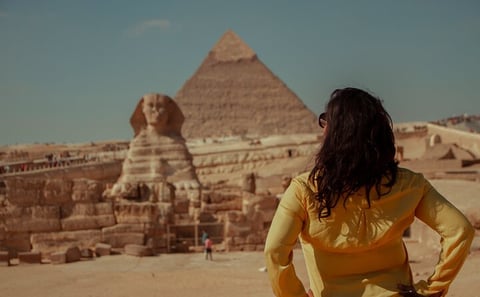
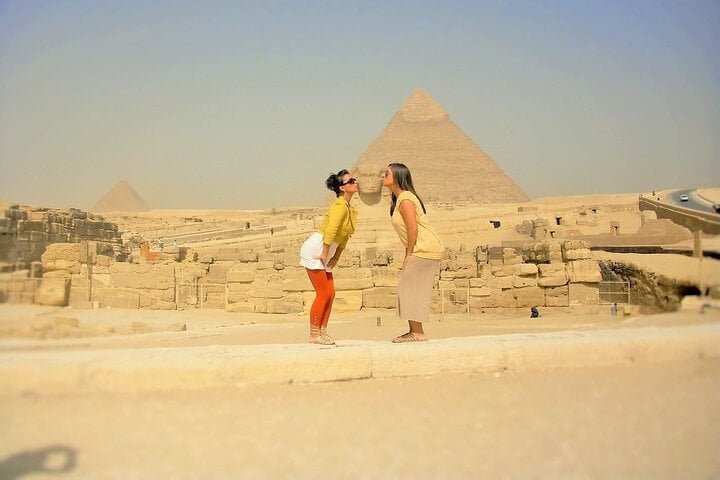
The Giza pyramid complex, also called the Giza Necropolis, is the site on the Giza Plateau in Greater Cairo, Egypt that includes the Great Pyramid of Giza, the Pyramid of Khafre, and the Pyramid of Menkaure, along with their associated pyramid complexes and the Great Sphinx of Giza. All were built during the Fourth Dynasty of the Old Kingdom of Ancient Egypt.
The site is at the edges of the Western Desert, approximately 9 km (5 mi) west of the Nile River in the city of Giza, and about 13 km (8 mi) southwest of the city centre of Cairo.
The Great Pyramid and the Pyramid of Khafre are the largest pyramids built in ancient Egypt, and they have historically been common as emblems of ancient Egypt in the Western imagination.They were popularised in Hellenistic times, when the Great Pyramid was listed by Antipater of Sidon as one of the Seven Wonders of the World. It is by far the oldest of the ancient Wonders and the only one still in existence.
Khafre's pyramid complex consists of a valley temple, the Sphinx temple, a causeway, a mortuary temple and the king's pyramid. The valley temple yielded several statues of Khafre. Several were found in a well in the floor of the temple by Mariette in 1860. Others were found during successive excavations by Sieglin (1909–10), Junker, Reisner,
Khufu's pyramid complex consists of a valley temple, now buried beneath the village of Nazlet el-Samman; diabase paving and nummulitic limestone walls have been found but the site has not been excavated.[4][5] The valley temple was connected to a causeway which was largely destroyed when the village was constructed.
Menkaure's pyramid complex consists of a valley temple, a causeway, a mortuary temple, and the king's pyramid. The valley temple once contained several statues of Menkaure. During the 5th Dynasty, a smaller ante-temple was added on to the valley temple. The mortuary temple also yielded several statues of Menkaure.
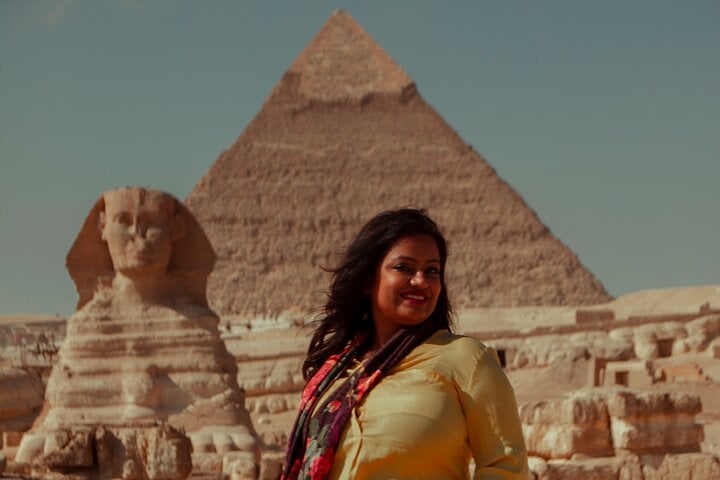
The Great Sphinx of Giza, commonly referred to as the Sphinx of Giza or just the Sphinx, is a limestone statue of a reclining sphinx, a mythical creature with the body of a lion and the head of a human. Facing directly from West to East, it stands on the Giza Plateau on the west bank of the Nile in Giza, Egypt. The face of the Sphinx is generally believed to represent the pharaoh Khafre.
Cut from the bedrock, the original shape of the Sphinx has been restored with layers of blocks. It measures 73 m (240 ft) long from paw to tail, 20 m (66 ft) high from the base to the top of the head and 19 m (62 ft) wide at its rear haunches. It is the oldest known monumental sculpture in Egypt and is commonly believed to have been built by ancient Egyptians of the Old Kingdom during the reign of the pharaoh Khafre (c. 2558–2532 BC).
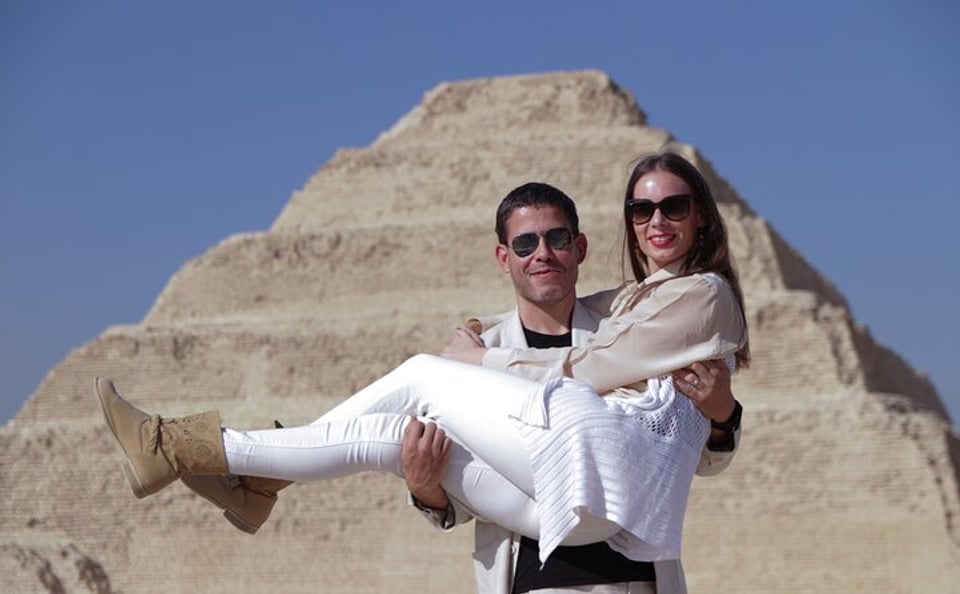
Saqqara (Arabic: سقارة, Egyptian Arabic pronunciation: [sɑʔˈʔɑːɾɑ]), also spelled Sakkara or Saccara in English /səˈkɑːrə/, is a vast, ancient burial ground in Egypt, serving as the necropolis for the Ancient Egyptian capital, Memphis.[1] Saqqara features numerous pyramids, including the world-famous Step pyramid of Djoser, sometimes referred to as the Step Tomb due to its rectangular base, as well as a number of mastabas (Arabic word meaning 'bench'). Located some 30 km (19 mi) south of modern-day Cairo, Saqqara covers an area of around 7 by 1.5 km (4.35 by 0.93 mi).
At Saqqara, the oldest complete stone building complex known in history was built; Djoser's step pyramid, built during the Third Dynasty. Another 16 Egyptian kings built pyramids at Saqqara, which are now in various states of preservation or dilapidation. High officials added private funeral monuments to this necropolis during the entire pharaonic period.
Memphis (Arabic: مَنْف Manf pronounced [mænf]; Bohairic Coptic: ⲙⲉⲙϥⲓ; Greek: Μέμφις) was the ancient capital of Inebu-hedj, the first nome of Lower Egypt. Its ruins are located near the town of Mit Rahina, 20 km (12 mi) south of Giza in Greater Cairo, Egypt.
According to legend, as related by Manetho, the city was founded by the Pharaoh Menes. It was the Capital of ancient Egypt during the Old Kingdom and remained an important city throughout ancient Egyptian history. It occupied a strategic position at the mouth of the Nile Delta, and was home to bustling activity. Its principal port, Peru-nefer, featured a high density of workshops, factories, and warehouses that distributed food and merchandise throughout the ancient kingdom. During its golden age, Memphis thrived as a regional centre for commerce, trade, and religion.
The pyramid of Unas (Egyptian: Nfr swt Wnjs "Beautiful are the places of Unas") is a smooth-sided pyramid built in the 24th century BC for the Egyptian pharaoh Unas, the ninth and final king of the Fifth Dynasty.[9][a] It is the smallest Old Kingdom pyramid, but significant due to the discovery of Pyramid Texts, spells for the king's afterlife incised into the walls of its subterranean chambers. Inscribed for the first time in Unas's pyramid, the tradition of funerary texts carried on in the pyramids of subsequent rulers, through to the end of the Old Kingdom, and into the Middle Kingdom through the Coffin Texts that form the basis of the Book of the Dead.
The Pyramid of Teti, located in Saqqara, Egypt, is a captivating ancient structure built as the final resting place for Pharaoh Teti. Standing as a testament to the ingenuity and architectural prowess of the Old Kingdom, this pyramid attracts visitors from around the world with its impressive size and historical significance. Explore the chambers and corridors of this pyramid to uncover the mysteries of ancient Egypt and immerse yourself in the rich history of this iconic landmark.
The Mastaba of Ti is one of the most important archaeological sites of Saqqara. The mastaba was discovered by Auguste Mariette. After the tour ends you will be transferred back to your hotel
The mastaba contains two serdabs. The walls of the tomb show various scenes of everyday life.
Fully refundable until 1 day before start
Non-refundable after 1 day before start
Elite
Free Cancellation · Instant confirmation · Private tour
Free Cancellation · Instant confirmation · Private tour

Free Cancellation · Instant confirmation · Meet on location or pickup

Free Cancellation · Instant confirmation · Private tour
Free Cancellation · Instant confirmation · Private tour
Free Cancellation · Instant confirmation · Private tour
Free Cancellation · Instant confirmation · Private tour
Free Cancellation · Instant confirmation · Private tour