 Temporarily unavailable
6-Day Golden Triangle Tour with Ranthambore – Delhi, Agra & Jaipur
Free Cancellation · Instant confirmation · Private tour

Pick up from your hotel in Hyderabad and drive to Bijapur. En-route stop at Gulbarga to visit -
The Gulburga fort - a leftover of the Brahmani era, which has stood with the time and is famous for its incredible architecture. It was originally built by Raja Gulchand. Later, 15 towers were added by Allah-ud-din Bahmani in the existing structure of the fort. The fort was built with well planning the canal was made around the fort so that it becomes difficult to the enemy. The fort contained 15 towers and 26 guns of which one was 8 metres long.
Jama Masjid - a Mosque located in Gulbarga City, it is regarded as one of the most architectural mosques in its form and structure in South Asia. The arches design of Jama Masjid Gulbarga reflects in the interiors of Spanish Mosque of Hyderabad. These are only two mosques in India which have the similarity in interiors of the Great Cathedral–Mosque of Córdoba in Spain.
Continue drive to Bijapur check in at hotel.
Overnight at hotel.
The Bijapur Fort - located in the Bijapur city Bijapur fort has a plethora of historical monuments of architectural importance built during the rule of Adil Shahi dynasty. The Adil Shahi Sultans who ruled for nearly 200 years in Bijapur had expended their utmost authority, almost exclusively, on architecture and the allied arts, each Sultan endeavored to excel his predecessor in the number, size, or splendor of his building projects. As a result, the buildings seen in and around Bijapur Fort and the town have been rightly called as the Agra of South India.
Asar Mahal - Asar Mahal, built by Muhammed Adil Shah in late 1640s, used to serve as a Hall of Justice. It is also known as Mithari and Asar Mahal and stands with the support of four pillars. Moreover, hair from the beard of Prophet Muhammad was also used at this place. Owing to this, it is a place of worship for Muslim devotees.
Bara Kaman is the unfinished mausoleum of Ali Adil Shah II in Bijapur, Karnataka in India. Ali Adil Shah of the Adil Shahi dynasty wanted to build a mausoleum of unmatched architectural quality. It was planned that twelve arches would be placed vertically as well as horizontally surrounding the tomb of Ali Adil Shah. However for unknown reasons the work on the structure was left incomplete: only two arches were raised vertically.
Gol Gumbad situated in Bijapur district of Karnataka is the second largest dome in the world. The Gol Gumbad is second in size only to St. Peter's Basilica, Rome. The Gol Gumbad is 124 feet in diameter. The architecture of Gol Gumbad is unique in the sense that the four minarets themselves are the staircases, leading to the top dome.
Jama Masjid - The graceful twin minarets of Tipu's Jumma Masjid (1787) are decorated with an elegant arrangement of numerous pigeonholes, and terminate in bulbous domes above balconies. In modern times, processions assemble here before making their way across the island to Gumbaz and the ceremonies associated with the Tipu Urs (marking the anniversary of Tipu's death). Prayers are offered, both at the mosque and at the mausoleum.
Malik - e- Maidan - regarded as the biggest cannon ever made in the history of world, Malik-e-Maidan, which translates to ‘The Ruler of the Plains’. Located in Gol Gumbaz, the largest masonry dome in the whole of India, the history related to the cannon is more than enough to tempt the travelers to pay a visit to this place.
The Ibrahim's Rouza - The Ibrahim Rauza was built by Ibrahim Adil Shah in the 15th century. It consists of mosque and tomb enclosed together in the square compound. Mosque and Tomb are separated from each other by tank and fountain. The mosque has finely crafted arches in its rectangular prayer hall and it’s shaded by chhaja and slender minarets at each corner. The bulbous dome with beautiful rows of petals at its base is enclosed in a square structure giving a majestic look to the mosque. Gol Gumbad situated in Bijapur district of Karnataka is the second largest dome in the world. The Gol Gumbad is second in size only to St. Peter's Basilica, Rome. The Gol Gumbad is 124 feet in diameter. The architecture of Gol Gumbad is unique in the sense that the four minarets themselves are the staircases, leading to the top dome.
Late afternoon drive to Badami check in at hotel.
Overnight at hotel.
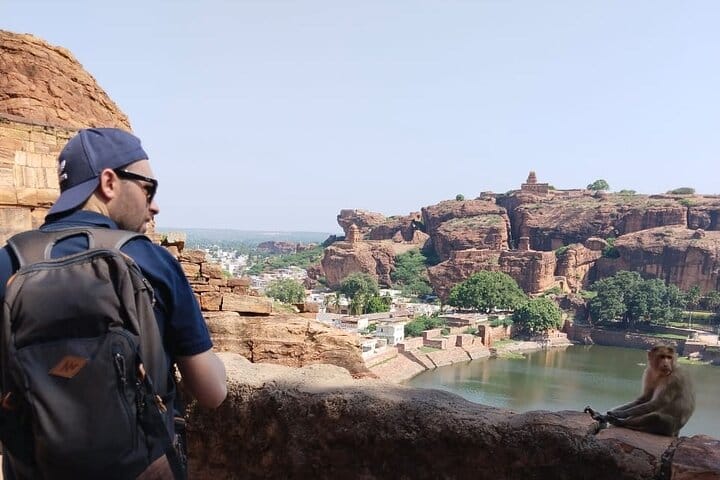
Badami Caves - The Badami cave temples are a complex of temples located at Badami, a town in the Bagalkot District in the north part of Karnataka, India. They are considered an example of Indian rock-cut architecture, especially Badami Chalukya Architecture. Badami, the capital of the Early Chalukyas, who ruled much of Karnataka in the 6th to 8th centuries, lies at the mouth of a ravine with rocky hills on either side and a town tank in which water from the ravine flows. The town is known for its ancient cave temples carved out of the sandstone hills above.
Badami Fort - Located in the Bagalkot district of North Karnataka, Badami is known for its beauty and rich history. Ruled by Chalukya’s in ancient times, Badami is a must visit tourist site in state of Karnataka. In Badami, Badami Fort is the most well-known archaeological site soaked in the history of the Chalukyas and the Pallavas.
Open Air Museum - To get a sense of the splendour of all three towns, visit a ‘natural’ National Museum in Badami! This is an area in where the artisans tried out their art — rock-cut steps, caves and incomplete idols tried out as a first draft are cordoned off here.
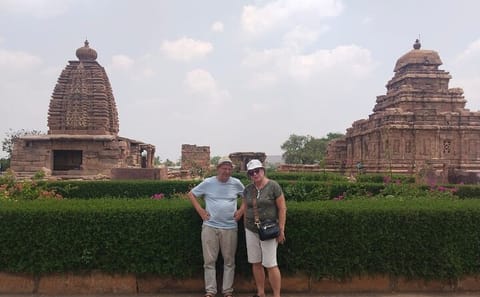
Pattadakal Temple Complex - a complex of 7th and 8th century CE Hindu and Jain temples. Located on the west bank of the Malaprabha River, this UNESCO World Heritage site is historically significant centres of Chalukya monuments. UNESCO has described Pattadakal as "a harmonious blend of architectural forms from northern and southern India" and an illustration of "eclectic art" at its height. The Hindu temples are generally dedicated to Shiva, but elements of Vaishnavism and Shaktism theology and legends are also featured. The friezes in the Hindu temples display various Vedic and Puranic concepts, depict stories from the Ramayana, the Mahabharata, the Bhagavata Purana, as well as elements of other Hindu texts, such as the Panchatantra and the Kiratarjuniya. The Jain temple is only dedicated to a single Jina. The most sophisticated temples, with complex friezes and a fusion of Northern and Southern styles, are found in the Papanatha and Virupaksha temples. The Virupaksha temple is an active house of Hindu worship.
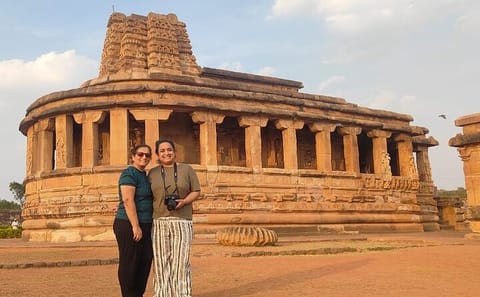
Durga Temple Aihole - an example of southern (Dravidian) architectural type, with a later northern type superstructure imposed upon it-an incongruity apparent from the fact that the superstructure is a square structure clumsily fitted over an apsidal cella. The temple stands on a high moulded upapitha (sub-base), apsidal on plan and carrying a peripheral row of columns on its edge that surround the moulded adhishthana and walls of an apsidal vimana and its front mandapa.
Hucchamalli Temple Aihole - The Huchimalli Gudi is home to shrines of Lord Shiva, Vishnu and Brahma. It was built in the 7th century AD and is considered one of the earliest groups of temples in Aihole. The sanctum is inclusive of a pradakshinapatha and a Northern style rekhanagara tower; and contains lattices on the external walls. Another small temple that dates back to the 11th century AD is situated to the north of this temple. At this temple, the entrance hall in front of the sanctum was introduced for the first time.
Meguti Jain Temple Aihole - The Meguti Temple has the distinction of being the only temple in Aihole which can clearly be traced back to 634 AD. Perched above a small hill, this temple, though incomplete, represents the early development of the Dravidian style of architecture. Built without mortar, the Meguti Jain Temple placed is on a raised platform with a flight of steps leading to the large, pillared mukhamandapa.
Ravanapadhi Cave temple Aihole - The 6th century cave temple is dedicated to Shiva. A broken column lines up with the cave entrance, which opens to the southwest. The cave is dramatically recessed on a deep ledge, with free-standing shrines on either side.
Rest time free and easy to relax in your hotel.
Overnight at hotel.
Breakfast at hotel drive to Hampi enroute visit -
Gadag - Trikuteshwara temple is a Hindu temple dedicated to Shiva. The carved temple is in the town of Gadag It is dedicated to Shiva and has three lingas mounted on the same stone. There is a shrine dedicated to Saraswathi in this temple and it has carved columns.
Lakkundi - is full of ruined temples like Mallikarjuna, Virabhadra, Manikeshwara, Nanneshwara, Lakshminarayana, Someshwara, Nilakanteshwara and many more.
Continue drive to Hampi check in at hotel. Rest time free and easy to relax.
Overnight at hotel.
Hazara Rama Temple - situated in the midst of the Royal Enclosure, is one of the prime attractions of Hampi. This site was used only for ceremonial processions and is renowned among devotees for its bas-relief sculptures that represent important events that occurred in Ramayana. It is one of the popular temples dedicated to Lord Vishnu in Hampi region. The walls of this temple are adorned with 15th century art work, such as carvings of elephants, horses, soldiers and dancing girls.
King's Balance - Remember all those fanciful tales of Kings weighing themselves with gems, rubies and gold? Well, it's at Hampi where they seem to take on life with King's Balance being one such pleasant affirmation. 5 meters tall and carved out of stone, King's Balance appears like a lonesome archway left standing, but peer closely and you can spot the three loops on the beam where the balance must have hung.
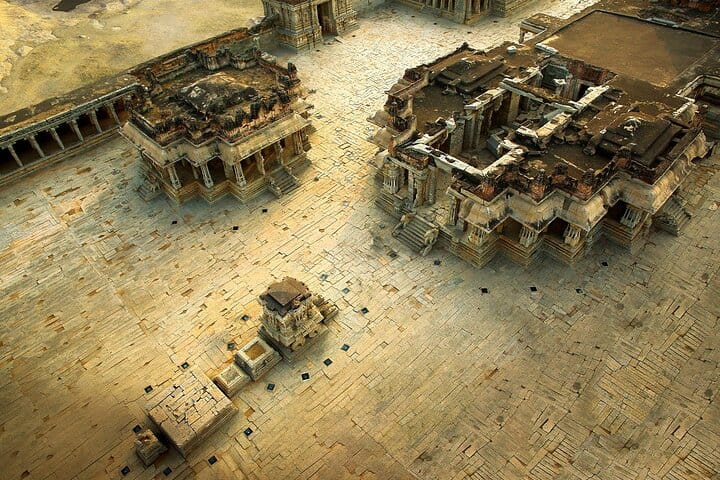
Mahanavami Dibba - The Mahanavami Dibba, a square structure, is another popular attraction in Hampi, which was constructed by the King Krishnadevaraya after his win over Udayagiri (in present-day Orissa). This ancient site is the tallest structure in the Royal Enclosure of Hampi and can be easily observed from nearby places due to its height. It is on the must visit list of all tourists because of its ornate carvings and historic importance.
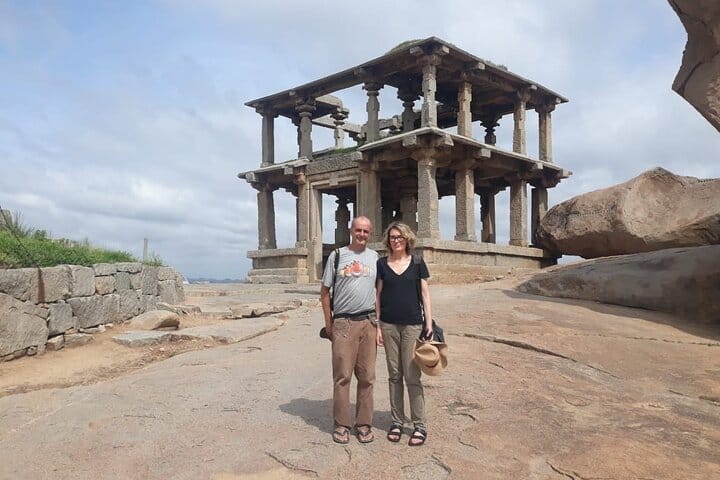
Royal enclosures - The Royal Enclosure of Hampi has often been compared to an open air museum. Apart from giving the visitor a glimpse into what life was like under the Vijayanagara rulers, it also showcases the architectural excellence of the era and the level of destruction the city witnessed after the decline of the Vijayanagara kings.
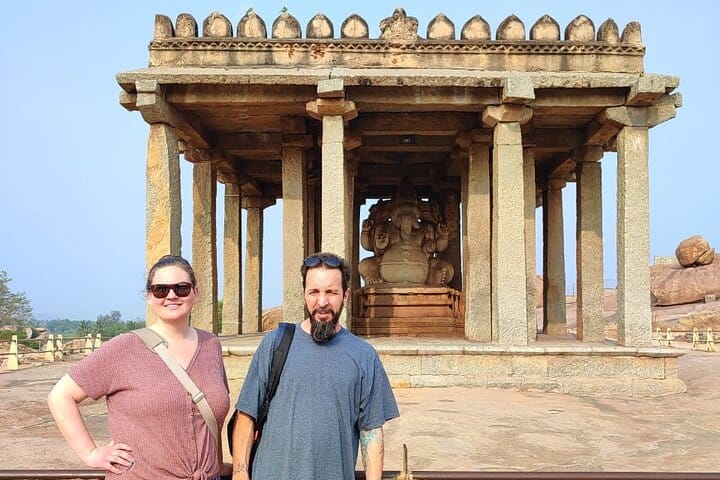
Ugra Narasimha Statue, Hampi is a statue of Laxmi Narasimha. The statue is carved out of a single block of stone. This single stone structure of Lord Narasimha is a major Tourist Attraction in Karnataka and is considered to be an important Monument in Karnataka. The Ugra Narasimha Statue is located to the south of Hampi.
Virupaksha Temple - This temple, in worship, known as ‘Shri Lokeswara-Maha-Sila-prasada’ from the epigraphs, was built by Lokamahadevi, the Queen of Vikaramaditya in about to commemorate her husband’s victory over the Pallavas of Kanchipuram. It closely resembles the Kailasanatha temple at Kanchipuram on plan and elevation and represents a fully developed and perfected stage of the Dravidian architecture.
Vithala And Lotus Mahal - a nice place in the Hampi with sufficient time greens and romantic ambience. One of the great place in zenana enclosure. The features of building is marvellous and splendid.
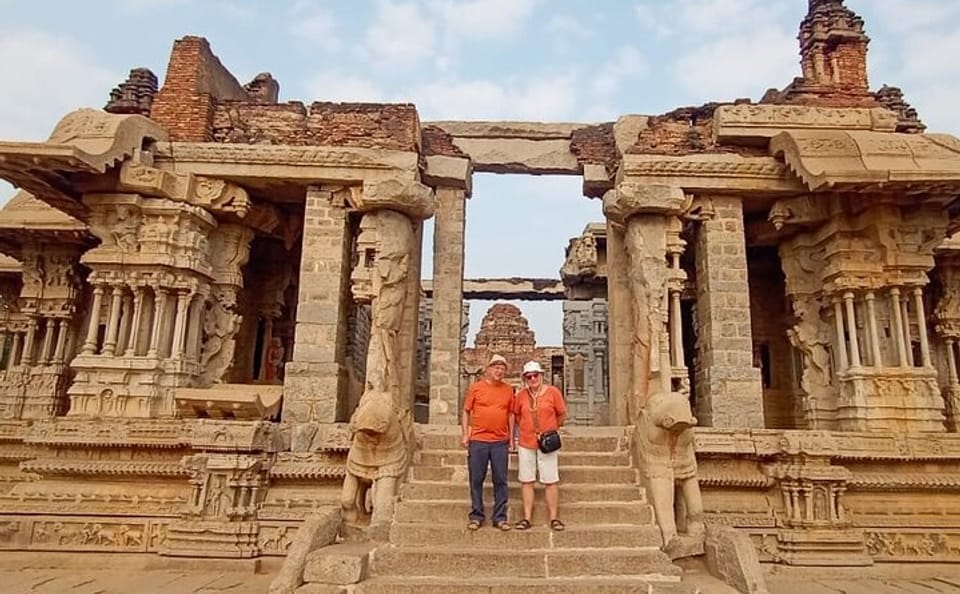
Vithala Temple Complex - Vittala Temple is a 16th century structure that is dedicated to the Lord Vittala or Lord Vishnu. It is a 'must see' site for all tourists going to Hampi because of its beautiful, complex carvings and magnificent architecture, which is not matched by any other structure located here. This temple, situated on the southern bank of the Tungabhadra River, represents the original South Indian Dravidian temple architectural style.
Rest time free and easy to relax in your hotel.
Overnight at hotel.
Breakfast at hotel drive to Hyderabad and drop off to your hotel or airport.
Fully refundable until 2 days before start
Non-refundable after 2 days before start
Temporarily unavailable
Free Cancellation · Instant confirmation · Private tour
 Temporarily unavailable
Free Cancellation · Instant confirmation · Private tour
 Temporarily unavailable
Free Cancellation · Instant confirmation · Private tour
 Temporarily unavailable
Free Cancellation · Instant confirmation · Private tour
Free Cancellation · Instant confirmation · Private tour
Free Cancellation · Instant confirmation · Private tour
Free Cancellation · Instant confirmation · Private tour
Free Cancellation · Instant confirmation · Private tour
Our assistant finds tours and checks live dates and prices, and answers your questions.