

 Elite
Elite
Puebla and Cholula Private Day Tour from Mexico City
Free Cancellation · Instant confirmation · Private tour

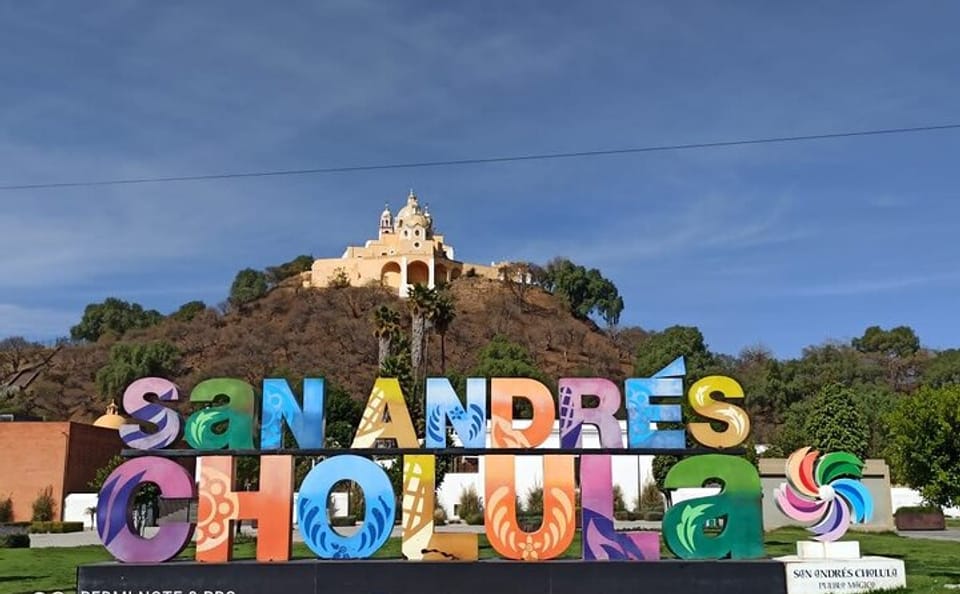
It is not known exactly when the pyramid began to be built but archaeologists believe that it was in 300 BC or the beginning of the Christian era. It is estimated that its completion took between 500 and 1000 years.
The construction of the temple of Chiconaquiahuitl (god of the nine rains) was carried out over several generations. It began in the second century before our era, and ended with the fall of Teotihuacán, which was the last pre-Hispanic culture that printed its seal on the great basement (900 AD-1100 AD), before the Arrival of the Spaniards. One of the constructive practices of the Mesoamericans was the remodeling of old buildings, remodeling that had the objective of expanding and maintaining the original constructions, so the long construction period of this temple must be understood in that context.
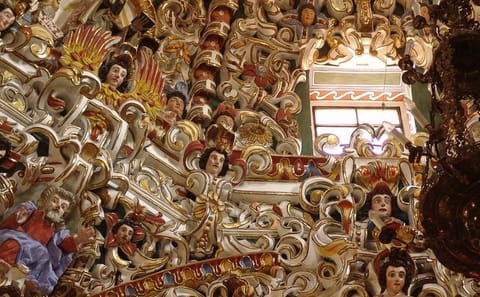
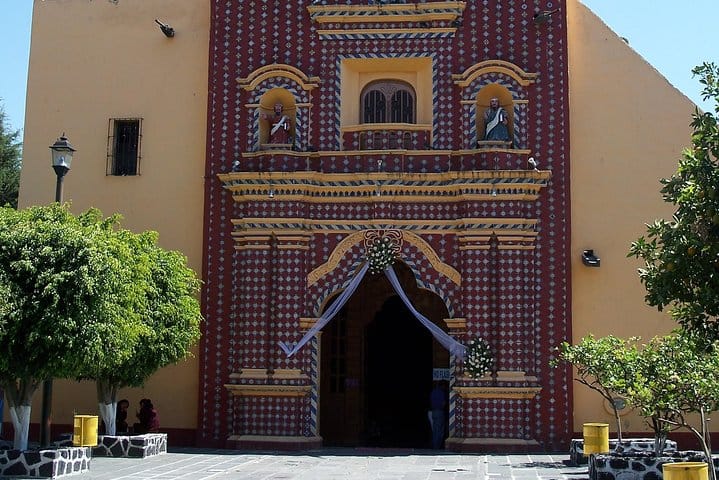
Two religious interpretations coexist in the Church of Tonantzintla, the indigenous one and the Christian one brought by the Spanish.
Santa María Tonantzintla is a small municipality in San Andrés Cholula, 10 minutes from the capital of the state of Puebla, Mexico. The main attraction is its church considered the maximum expression of the indigenous baroque. In the Mexica culture Tonantzin was a goddess identified with the Earth. The word Tonantzintla comes from Nahuatl and means place of our mother. With the arrival of the Spaniards, the name of Santa María was added, in honor of the Virgin Mary.
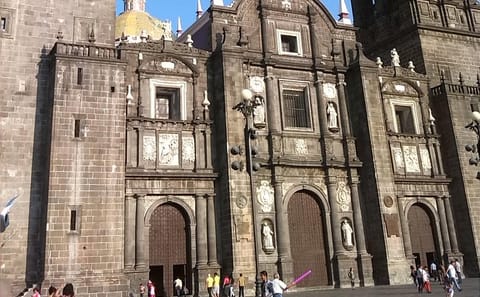
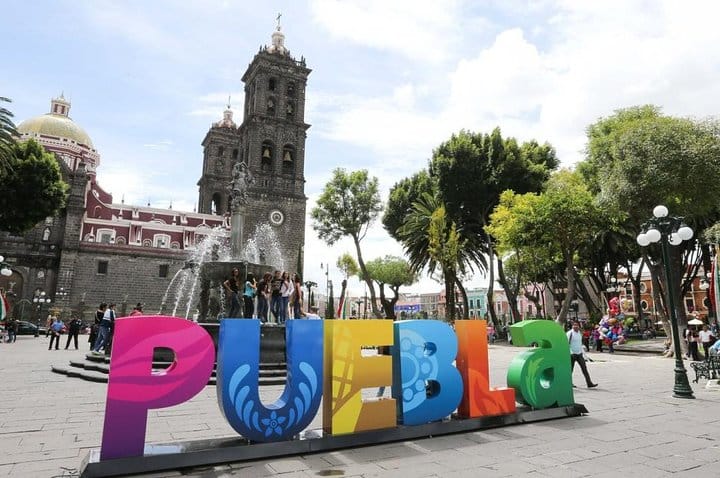
The Cathedral Basilica of Puebla, as the Cathedral of Our Lady of the Immaculate Conception is known according to its Marian dedication, is the episcopal seat of the Archdiocese of Puebla (Mexico). It is one of the most important buildings in the historic center declared a world heritage site. It has the prerogative of being the first sumptuous temple that under good designs was made in America, consecrated in 1649 it was ahead of the Metropolitan of Mexico that was dedicated in 1653. It was founded by Felipe II of Spain.1
The current Herrerian-style cathedral was built between the 16th and 17th centuries, and replaced the previous one that existed in what is now the atrium. From the beginning of its construction in 1575 to its consecration, 74 years elapsed which are located during the period of three kings of Spain, Felipe II, Felipe III and Felipe IV. Setbacks throughout those years allowed numerous modifications to the original trace. By 1624 the works were suspended in their entirety until the arrival of Bishop Juan de Palafox y Mendoza in July 1640, who resumed the works with determined enthusiasm. The new reforms gave a greater elevation to the central nave above the processional ones, allowing the passage of natural light and giving it an appearance of a pyramidal structure. It was consecrated by Bishop Juan de Palafox y Mendoza on April 18, 1649 without having been totally finished.
The cult of the Virgin of the Rosary was promoted by the order of Dominican preachers, who dedicated a chapel to her devotion in each of their convents. In Mexico it was not the exception when the first religious of the order arrived in 1526, but it was not until the year of 1531 when they began the construction of their first important temple in Puebla, which is also dedicated to the archangel San Miguel, however the chapel of the Rosario was conceived until 1650 and consecrated in 1690.
This type of construction is a reflection of the economic scope of the church in those years and the ambition and sumptuousness with which its temples were planned and erected.
The plant is arranged in the shape of a Latin cross, with short arms and head. The nave is divided into three sections and its vault is barrel-shaped with lunettes in the same way as the arms of the transept, it has a narrow dome with a drum and on this some windows and on the other half, whose purpose is to illuminate the sumptuous cypress just below.
The interior of the chapel is majestic, where the architectural structures have been covered in every corner that is observed with golden stucco reliefs, in order to exalt the religious feeling.
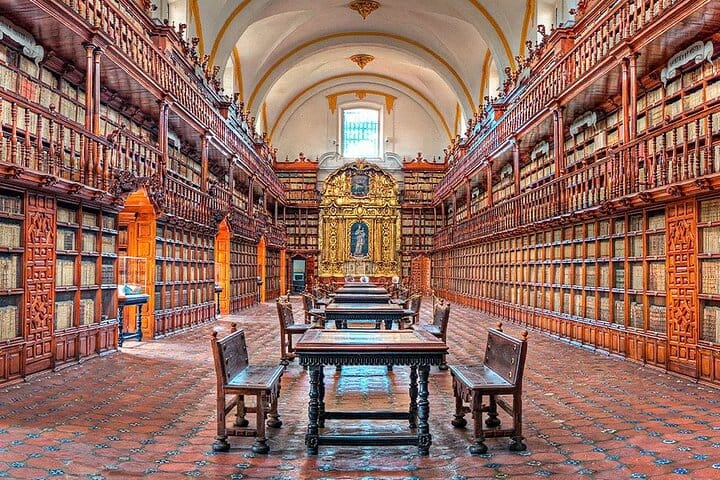
The Palafoxiana Library is a bibliographic site in the city of Puebla, founded by Bishop Juan de Palafox y Mendoza in 1646.1 Located in the historic center of the city of Puebla de los Ángeles, it has been a Historical Monument of Mexico since 1981 and since 2005 It was included by UNESCO as part of the Memory of the World Program. It was the first public library in America.
In 1646, Bishop Palafox donated his personal library, consisting of five thousand volumes, to the Seminary of San Juan but instructed that in addition to the clergy it could be consulted by all those who wanted to study, since its main condition was that it be open to the public and not only to ecclesiastics and seminarians.
The creation of this library was approved by royal decree in December 1647 and reconfirmed by Pope Innocent X in 1648.
For more than 370 years, the Palafoxiana Library has been located in the Old College of San Juan within the Seminary founded by Palafox and Mendoza. Although the construction of the vault, as it is today, was carried out in 1773, by Bishop Francisco Fabián y Fuero, who ordered the first two floors of the shelf to be raised, which is a fine work of the New Spain cabinetmakers that The woods of ayacahuite, polocote and cedar worked harmoniously. The delicate altarpiece where the effigy of the Madonna of Trapani is located dates from this period, an oil that is presumed to have been made taking as a model the sculpture that Nino Pisano made of the Virgin in the 14th century. Later, in the 19th century, a third level was placed due to the fact that the number of volumes that were in the library had increased, in fact the library has 45 058 old books.
Fully refundable until 1 day before start
Elite
Free Cancellation · Instant confirmation · Private tour
Free Cancellation · Instant confirmation · Meet on location
Free Cancellation · Instant confirmation · Meet on location
 Elite
Elite
Free Cancellation · Instant confirmation · Private tour
 Elite
Elite
Cancellable until 1 day before · Instant confirmation · Private tour
 Elite
Elite
Cancellable until 1 day before · Instant confirmation · Private tour
 Elite
Elite
Cancellable until 1 day before · Instant confirmation · Private tour
 Elite
Elite
Cancellable until 1 day before · Instant confirmation · Private tour
Our assistant finds tours and checks live dates and prices, and answers your questions.