

Private Walking Tour of Katskhi Pillar in Chiatura, Georgia
Free Cancellation · Instant confirmation · Private tour

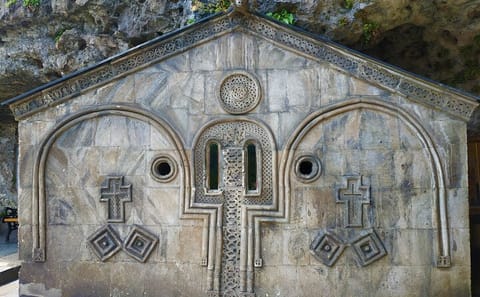
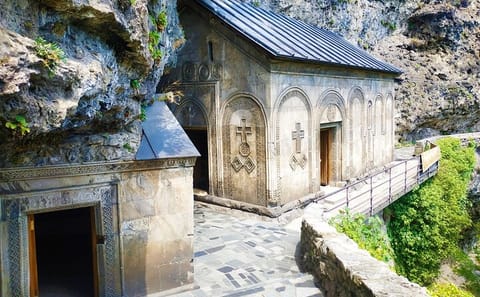
Mghvimevi (cave) Mothers' Monastery is a 13th century two-nave basilica, dedicated to the Nativity of the Mother of God partly carved into rock. The complex includes a small hall church, bell-tower, and a circuit wall. Small caves around the monastery served as refuges during wartime. The facade has carvings around the window, monumental crosses, interlocking rhombuses, cornice carvings, etc. Wooden iconostasis depicts the Savior and Twelve Apostles and various scenes from the life of Jesus made in the 18th century.
Chiatura is a mining town in a mountain valley of the Qvirila River. In 1879 the Georgian poet Akaki Tsereteli discovered the manganese and as a mining colony, Chiatura quickly became a source for manganese and iron and was declared a city in 1921. Due to the steep sided river valley, workers spent a large amount of time walking up from the town to the mines, thereby reducing productivity. In 1954 cable car system was installed to transport workers. Still utilizing the original infrastructure of the 1950s, today 17 cable car systems still exist. The central hub with 4 lines is being rebuilt with modern cable car technology.
Katskhi Monastery of Nativity of the Savior is a medieval monastery built by the Baguashi family in the period of 988–1014. The church building is noted for a hexagonal design and rich ornamentation. The exterior of the church features three gradually narrowing cylindrical levels. The building was richly ornate, but the decoration of two upper tiers was lost in the process of the 1854 restoration. The relief at the southern vestibule is the Exaltation of the Holy Cross, featuring a cross supported by four angels. The church is surrounded by a pentagonal wall with a free-standing bell tower added in the 17th or 18th centuries.
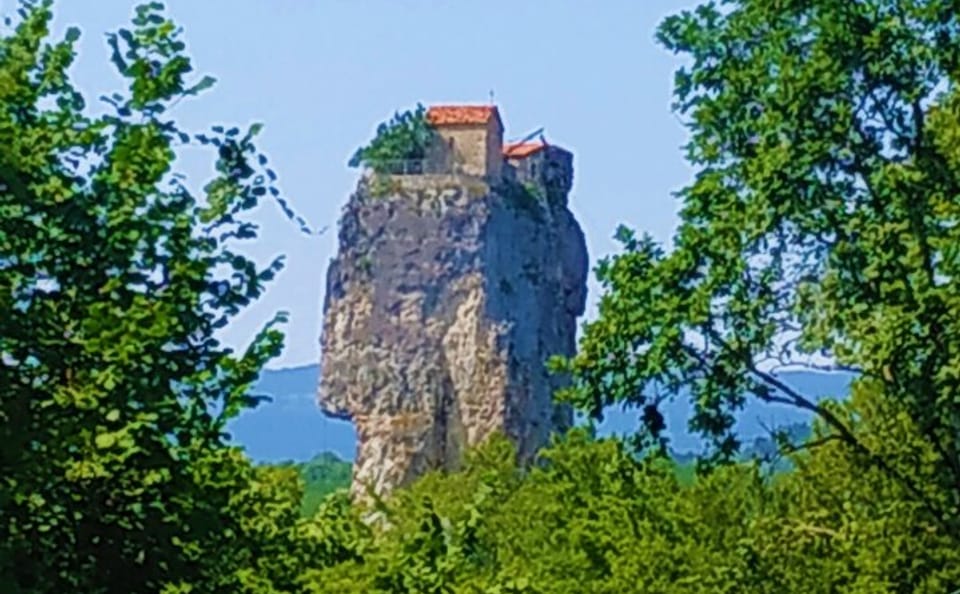
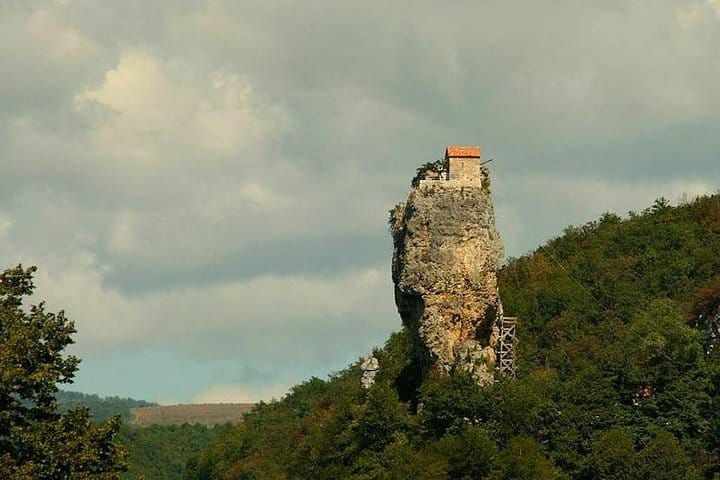
The Katskhi pillar is 40 meters high natural limestone monolith that overlooks the small river valley of Katskhura dating from the 9th-10th century. The Katskhi pillar complex consists of a church of Maximus the Confessor, a burial vault, three hermit cells, a wine cellar, and a curtain wall on the top of the column. At the base of the pillar are the newly built church of Simeon Stylites, ruins of an old wall and belfry and a Bolnisi cross relief. A number of local legends surround the pillar. One of the legend is that the top of the rock was connected by a long iron chain to the dome of the Katskhi church, located 1.5 km away.
Ubisa is a medieval monastic complex founded by Grigol Khandzteli in the 9th century. It was later renewed by Simon Chkondideli in 1141. In the 14th century, during the reign of George the Magnificent, the main temple of the monastery was decorated with unique frescoes. The "Last Supper" of Ubisa Monastery is a new style of the 14th century Georgian artist Damian and his student Gerasim. This fresco proves that Georgia had its courage towards the Renaissance earlier in the Middle Ages. Before the great Italian Leonardo da Vinca (painted in 1495 to 1498), a fish appears on the table of Ubisa's "Last Supper" and human gestures and facial expressions in the faces of saints.
Fully refundable until 1 day before start
Non-refundable after 1 day before start
Free Cancellation · Instant confirmation · Private tour
Free Cancellation · Instant confirmation · Meet on location
Free Cancellation · Instant confirmation · Meet on location
Free Cancellation · Instant confirmation · Min age 18+
Free Cancellation · Instant confirmation · Private tour
Free Cancellation · Instant confirmation · Private tour
Free Cancellation · Instant confirmation · Private tour
Free Cancellation · Instant confirmation · Private tour
Our assistant finds tours and checks live dates and prices, and answers your questions.