
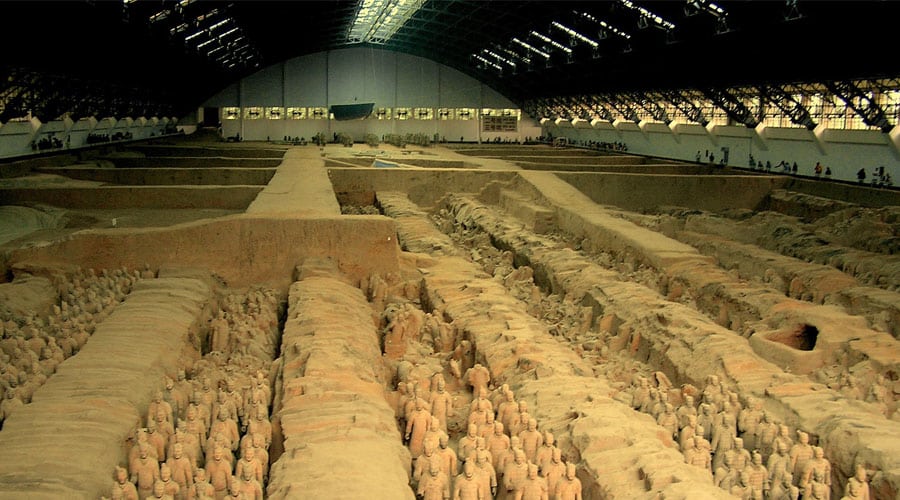
The Terracotta Army in Xi’an, China (the world-famous Terracotta Warriors and Horses) is the burial guard of Emperor Qin Shi Huang (259–210 BCE), the ruler who first unified China. More than fifty years after farmers stumbled upon it in 1974, the complex remains one of the most important archaeological discoveries of the modern era: a UNESCO World Heritage centerpiece and the heart of today’s Emperor Qinshihuang’s Mausoleum Site Museum. In 2026, new science, rare finds in the pits, and smoother digital logistics make visiting Xi’an for the warriors more rewarding than ever, whether you care about deep history, photography, or a smooth family day out.
Why the Terracotta Army still matters in 2026
What began as a ruler’s afterlife project has become a living laboratory: archaeologists combine traditional excavation with 3D scanning, ground-penetrating radar, and conservation science to decode how the Qin Dynasty (221–207 BCE) organized labor, war, and empire. For travelers, that means refreshed galleries, clearer stories in the museum, and a visitor experience that is easier to plan—if you book ahead and understand transport and payments.
The First Emperor and the dream of an underground empire
The ideological engine behind the army is the ambition of Ying Zheng, who became King of Qin at about thirteen and later proclaimed himself Qin Shi Huang—“First Emperor”—after unifying rival states. His mausoleum zone was conceived not only as a tomb but as a subterranean mirror of the realm: palatial structures, support facilities, and a standing force to face threats even in the next world.
Ancient historian Sima Qian described vast underground palaces and symbolic rivers; modern soil studies around the burial mound have recorded mercury anomalies consistent with those legends—another reason the central tomb remains unopened, protected from rushed excavation and exposure. What you see today in the pits is the outer architecture of that vision: rank, discipline, and staggering scale.
| When | What happened |
|---|---|
| 246 BCE (trad.) | Young king; mausoleum project begins. |
| 221 BCE | Unification of China; imperial title and expansion of works. |
| 210 BCE | Death of the First Emperor. |
| 208 BCE | Large-scale construction falters as the Qin order collapses. |
| March 1974 | Accidental discovery near the mausoleum while digging a well. |
| 1987 | Inscribed as a UNESCO World Heritage Site. |
Who built it—and at what scale
Traditional accounts credit Minister Li Si with planning and General Zhang Han with supervising vast work gangs; laborers included artisans and potters mobilized across the empire. Sima Qian’s figures suggest on the order of 700,000 workers over roughly 38 years—a logistical feat that helps explain both the army’s uniformity and its workshop-style production.
“Eighth Wonder of the World” and the leaders who made the pilgrimage
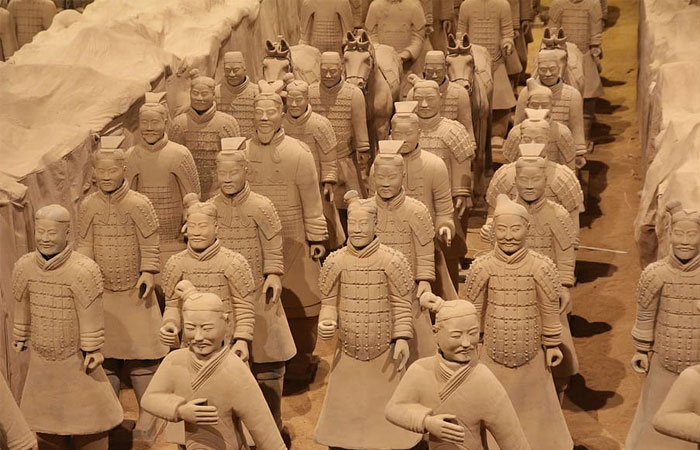
In 1978, Jacques Chirac (then a leading French statesman) famously praised the site in terms that helped cement global fame as an eighth wonder-class marvel. Since the 1970s, the pits have hosted heads of state and cultural figures from many countries—including, over the years, leaders such as Lee Kuan Yew, Ronald Reagan, Bill Clinton, and Vladimir Putin—a reminder that the army is both a scientific site and a stage for diplomacy.
The excavation pits: strategy frozen in clay
The terracotta forces are organized across three principal pits, each with a distinct military role. Allow roughly 3–5 hours for the warrior museum alone if you want photographs, labels, and breathing room.
Pit 1: the main infantry army
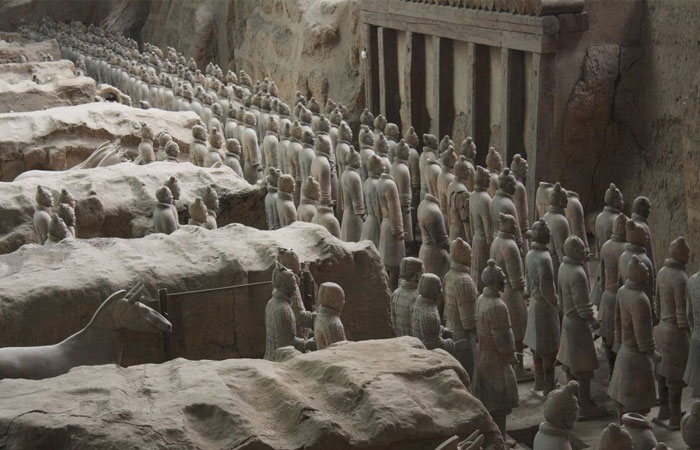
Pit 1 is the largest and most iconic hall—on the order of 230 meters long—where ranks of infantry and chariots form a disciplined battle array. Most figures face east, toward the world of former rivals, as if on permanent alert. Green brick paving and collapsed timber roofs testify to ancient engineering—and to the fires and turmoil that buried the site after the Qin unravelled.
Pit 2: mixed arms, chariots, and the kneeling archer
Pit 2 is the tactically richest pit: cavalry, archers, chariot teams, and supporting units laid out across thousands of square meters—sometimes described as including on the order of 160 cavalry and 64 chariots in its wider interpretation of the remains. The celebrated Kneeling Archer, remarkably complete, helped scholars understand armor layering, hair buns, and even sole tread patterns on footwear.
2024–2025 highlight: excavations here produced a rare life-sized senior commander—one of only about ten high-ranking generals identified since 1974—distinguished by ornate armor and headdress. If you want a “what’s new” story for your visit, this find is the headline.
Pit 3: the command post
Pit 3, the smallest of the three, is interpreted as a headquarters: dozens of senior figures and a chariot team suggesting coordination rather than frontline shock action. Its position—about 25 meters northwest of Pit 1—fits the idea of a brain behind the brawn.
The unfinished fourth pit
Archaeologists also located a fourth pit that was left empty, poignant evidence that the emperor’s cosmic construction program was cut short as rebellion and civil war consumed the dynasty.
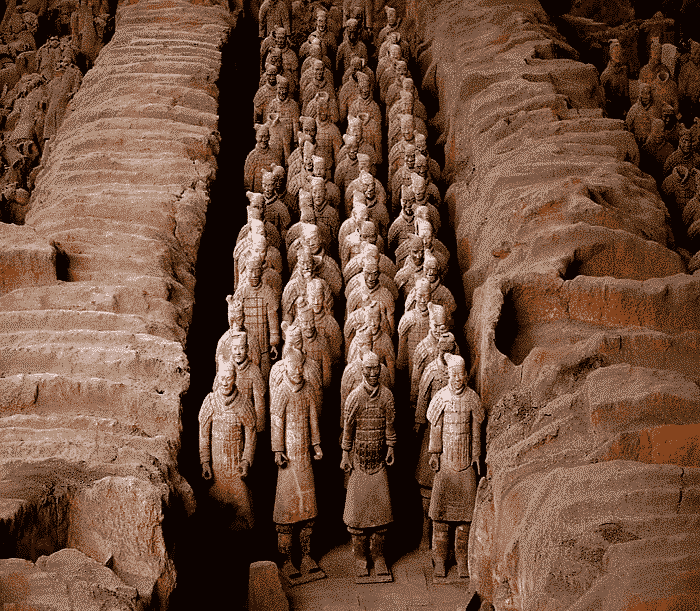
2024–2026 breakthroughs: science meets the First Emperor
- Non-invasive survey: ground-penetrating radar and related methods have helped locate anomalies and plan work without destroying stratigraphy.
- “More than we thought”: prospecting has pointed to over a hundred additional figures in areas not fully mapped earlier—hinting that the famous “~8,000 warriors” estimate may still grow.
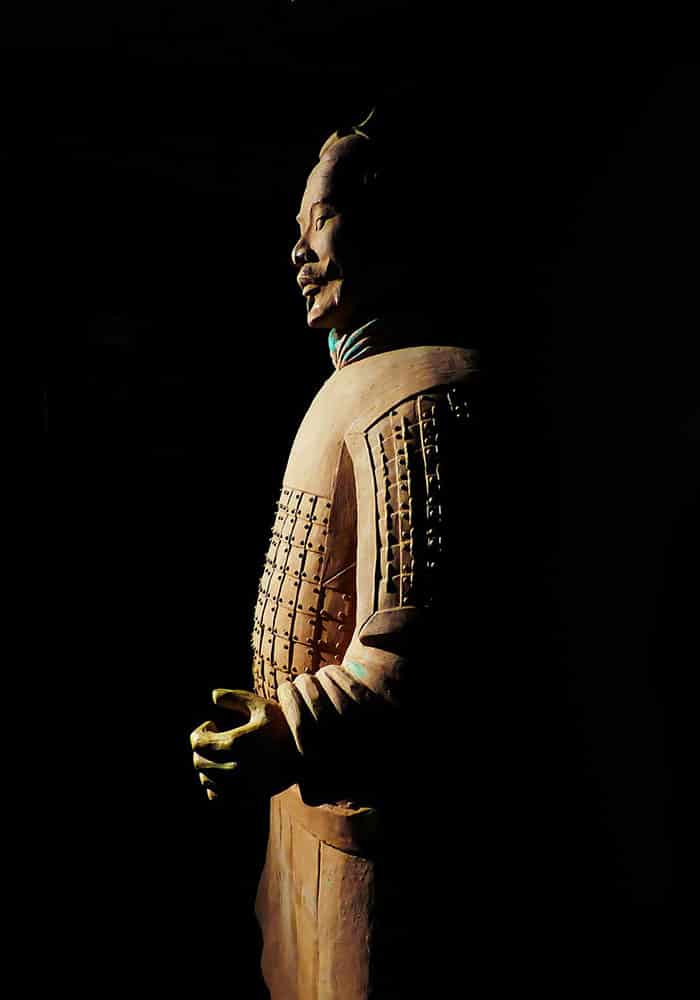
- 3D facial analysis: high-precision scans support the museum story that bodies were built in a modular way while faces were individualized—a merger of mass production and portrait-like craft.
- Color conservation: pigments such as Han Purple (an early synthetic purple) and vivid lacquer schemes are fragile; new stabilization workflows aim to save what instant exposure once destroyed.
Artistry, assembly lines, and blades that still impress metallurgists
The army is an early industrial organization in clay: torsos and heads could be formed from a limited set of molds, then joined and finished by hand so that no two soldiers look identical. Stature and costume signal role—officers and generals can approach roughly 1.9–2.0 meters in height, while common soldiers cluster lower.
Weapon finds are equally famous: tens of thousands of bronze items (swords, spearheads, halberds, crossbow components) some still keen after two millennia. Analysis points to surface treatments, including chromium-bearing layers that limited corrosion, technology that reads as shockingly modern on a lab chart.
Lishan Garden: bronze chariots, birds, acrobats, and officials
Your standard ticket includes Lishan Garden (the Mausoleum Site Park), where the story widens from battle lines to court life and bureaucracy. Take the free shuttle between the warrior museum zone and the park; if your legs are tired, the small fee for the electric cart is usually money well spent.
- Pit K9901 (Acrobat figures): entertainers and strongmen, proof that the afterlife had leisure, not only war.
- Pit K0006 (Civil officials): robed administrators, bureaucracy made literal in clay.
- Pit K0007 (Bronze aquatic birds): elegant cranes, swans, and ducks; some display may be routed through nearby exhibition halls—check on-site signage for what is open.
- Pit K9801 (Stone armor): thousands of stone armor pieces echoing real gear—spirit-world logistics.
- Museum of the Bronze Chariots and Horses: two extraordinary half-scale bronze models (thousands of parts, gold and silver detail)—a high point of ancient Chinese metalworking.
Practical guide for 2026: tickets, passport, payments, crowds
Booking: Treat the site like a major concert venue: during busy periods, online reservation is essential and a passport (or required ID) is central to real-name entry. Same-day walk-ups can disappoint when quotas fill.
Digital money: China runs on Alipay and WeChat Pay; foreign cards (Visa, Mastercard, and others) are increasingly linkable for visitors—handy for metro, snacks, and taxis. Keep a little cash as backup. Very large mobile payments sometimes carry a small surcharge—check your app’s fee notice before you confirm.
A smarter flow: the “reverse route” on busy days
Most group tours charge straight at Pit 1 in the morning. Independent travelers often enjoy: Lishan Garden first (mound + bronze chariots), then Pits 3 and 2, then Pit 1 around midday when tour buses thin—or late afternoon for softer light and thinner galleries.
How to get there from Xi’an
| Transport to the Terracotta Army (Lintong) | |
|---|---|
| Metro + bus (reliable) | Line 1 to Fangzhicheng, transfer to Line 9, exit Huaqing Pool (Exit C), then Lintong bus 602 or 613 toward the museum. Budget roughly 10–15 RMB. |
| Xi’an North Station | Dedicated shuttle MPV services have run on a frequent schedule—about 30 RMB and roughly an hour, subject to traffic. |
| Airport | Airport shuttle toward Lintong or the city center, then connect by bus or taxi; allow ~90+ minutes depending on mode. |
| Taxi / ride-hail | From downtown, often 45–60 minutes and roughly 150–200 RMB—verify on your app. |
| Classic bus routes | Older guides still mention lines such as 306/307 from railway stations or the city wall area; useful if you are staying near those hubs—confirm the latest numbers locally. |
2026 ticket snapshot
| Adult (standard) | Typically 120 RMB for the main pits + Lishan Garden (confirm on the official channel at booking time). |
| Children | Often free under 16 with an eligible ID—, current policy when you reserve. |
| Lishan electric cart | Small add-on (around 15 RMB)—saves time in the park. |
| Hours (usual pattern) | Often free under 16 with an eligible ID—verify current policy when you reserve. |
Pro context for your trip: If you have an extra half-day in the city center, the Shaanxi History Museum helps frame the Qin story beside the Tang and Han layers you will feel everywhere in Xi’an.
Pair the warriors with Xi’an’s other icons
Lintong is only part of the Xi’an circuit. Many travelers combine the army with the Xi’an City Wall, the Great Mosque quarter, or a landscaped evening at Tang Paradise—each a different dynasty’s answer to power, faith, and spectacle.
Curated experiences on Tripways
If you prefer door-to-door transport, pre-arranged tickets, and narrative depth, browse Tripways Xi’an tours and activities. Strong starting points:
- Private day tour: Terracotta Warriors & Lishan Garden—full-day logistics and guiding for the museum + park.
- ATV adventure toward the Terracotta Army—a high-energy approach through Lintong’s countryside before the history hits.
- Hands-on add-ons: family-friendly workshops to model a small warrior with local artisans—ideal after you have seen the originals.
- Broader China routing: see how Xi’an fits a longer itinerary via Tripways China destinations.
Before you go: quick checklist
- Reserve early, especially on weekends, holidays, and peak season.
- Carry a passport (or the ID the booking system requests).
- Install Alipay and/or WeChat Pay and test a small purchase.
- Wear comfortable shoes; the complex is larger than it looks on a map.
- Decide whether you want the shuttle + cart rhythm at Lishan before your legs complain.
The Terracotta Army is where imperial ambition, artisan skill, and modern science meet behind glass and on screens. However you travel, metro, shuttle, or a private car from go.tripways.com give yourself time to look twice: once for the spectacle, once for the human details in a single face.